Some schools are famous before you even meet them.
Say "Émile-Cohl," and for a lot of people, it immediately sounds serious. It smells like charcoal, life drawing, all-nighters, A3 sketchbooks poking out of bags, students who can draw a hand without crying. Well, almost.
In this episode, we sat down with Peulin, illustrator and tattoo artist, who spent five years at Émile-Cohl school in Lyon. A private school specializing in drawing, image-making, animation, illustration, comics, video games, and 3D.
On paper, it looks solid. The school has been around since 1984, prides itself on a rigorous curriculum heavily focused on observational drawing, and its degrees are state-recognized for certain programs. But between the official brochure and what you actually live through as a student, there can be a bit of a gap. Like, a gap with easels in it.
Peulin talks about what she learned there, what she lost there, and what the school left in her hands — and in her head.
A prestigious school, but not magic
Émile-Cohl is one of those schools that comes up fast whenever people talk about academic drawing in France.
The school describes itself as a "grande école of drawing" and highlights programs in illustration, 2D/3D animation, comics, video games, storyboarding, 3D modeling, and multimedia publishing. On its website, it really leans into the idea of training artists ready to work in the image industries.
And it's true: the program has a reputation. One that didn't come out of nowhere.
France Compétences, for example, describes the Dessinateur Praticien (Practicing Draftsman) diploma as a certification built on "excellence in observational drawing," designed as a common foundation for image-related careers: audiovisual, animated film, video games, publishing, illustration, comics.
So yeah, Émile-Cohl isn't just three stools, a white room, and someone saying "express yourself" for five years.
It's a school with a method. A real method. Very technical. Very structured. Very much "learn to draw what you see before you draw what you feel."
Peulin admits it without hesitation:
"For academic drawing, the training is very good."
And that matters. Because her account isn't a petty score-settling. It's not "everything sucked, let's burn the easels." She clearly separates what the school does well — technical training — from what it does less well: supporting people, encouraging experimentation, letting artistic identities breathe.
Five years in a drawing machine
When you ask Peulin how she experienced those five years, her first answer is simple:
"It was long."
And sometimes, that's already a whole critique.
Five years in a private art school isn't just five years of learning to draw. It's five years of producing, submitting, starting over, comparing, doubting, watching others move forward, wondering if you're in the right place, if you're good enough, if you deserve your spot, if you'd be better off opening a bakery specializing in sad cookies.
Peulin describes the school as "old school." And she's quick to clarify that in this case, "old school" isn't necessarily a compliment.
"Back when I was there, they didn't take care of students. They didn't listen to those who were struggling."
This point comes up a lot in former art students' accounts — not just from Émile-Cohl, by the way: rigor sometimes gets confused with harshness. As if suffering is part of the training. As if burnout is proof of seriousness.
The thing is, you can train strong artists without grinding them down along the way. At least, I think so. I'm not a school dean, but I've seen people learn stuff without being made to feel worthless every week.
Peulin also mentions hearing remarks during her time at the school that she describes as racist or misogynistic. These are her words, her experience, her account. That kind of statement should be reported carefully, but not erased. Because in a school, the atmosphere is part of the pedagogy. What's tolerated in the studios matters just as much as what's in the curriculum.
Academic drawing: Émile-Cohl's greatest strength
Where Peulin is clearest is on academic drawing.
Émile-Cohl is famous for it: observational drawing, life drawing, perspective, volume, construction, anatomy, composition. The hard fundamentals. The stuff that isn't very Instagrammable when you're in the middle of it, but saves you ten years later when you need to draw an arm that doesn't look like a celery stalk.
On its website, the school's preparatory drawing program advertises 800 hours of face-to-face instruction, with a heavy focus on observational drawing, object drawing, life drawing, sketching, sculpture, art history, and portfolio building. The 3D Designer program, meanwhile, clocks in at 1,034 to 1,204 hours of class per year, depending on the year, not counting internships.
So we're talking real intensity.
Peulin doesn't dispute that:
"For academic drawing, the training is very good."
But she immediately adds nuance:
"Once that foundation is established, the ones who were strong at the start stay strong, and the ones who struggled keep struggling."
That's maybe where her account gets interesting. She's not just saying "the school is tough." She's saying: the school teaches fundamentals, yes. But it doesn't always transform students equally.
In other words: if you show up already well-armed, confident, productive, with a solid graphic identity, you can make the most of the framework. If you show up more fragile, slower, still searching, more easily intimidated, the school can become a place where you mainly learn to survive.
And surviving is a skill. But it's not exactly the dream they sell in the brochure.
Finding your style in a school that values know-how above all
One of the strongest things Peulin says is about artistic identity:
"This is not a place where you find your artistic identity."
She explains that the school leaves little time for exploration, experimentation, failure, trying again differently. The pressure of deadlines and technical expectations tends to push you toward what's efficient. Toward producing what you already know how to do. Toward meeting the brief.
And that makes sense, to a degree. Émile-Cohl embraces a craft-based, technical approach. The school doesn't present itself as a Beaux-Arts institution. It doesn't primarily sell personal expression — it sells craft, know-how, the ability to meet a brief.
Peulin puts it this way:
"They're not there for personal expression, they want technical skill."
And that's not necessarily a bad thing.
It all depends on what you're looking for.
If you want to learn how to build an image, understand volume, draw from life, produce clean work, meet professional constraints, a school like Émile-Cohl can make sense.
If you want to explore your own universe, deconstruct your relationship with drawing, make installations with latex, silence, and a broken projector — first off, good luck — but more importantly, this might not be the most fitting place.
The problem is when the technical school takes up all the space. When know-how becomes an end in itself. When you know how to construct a perspective but no longer remember why you draw.
That's where Peulin places part of her inner disengagement.
"The opposite of Beaux-Arts": compliment or trap?
You often hear that Émile-Cohl is the opposite of Beaux-Arts.
Peulin confirms:
"Yes, that's clearly part of their identity."
In the collective imagination, Beaux-Arts is associated with research, freedom, contemporary art, conceptual experimentation. Émile-Cohl, on the other hand, represents controlled drawing, the hand, technique, craft.
It's almost a classic French debate: on one side, "the idea"; on the other, "the know-how." On one side, "I question the medium"; on the other, "I can draw a stool in cabinet projection."
The truth, obviously, is that an artist usually needs both. A hand that knows how to execute, and a head that knows why. Otherwise, you end up either with very beautiful but somewhat hollow images, or with very clever concepts drawn like furniture assembly instructions.
Peulin says she was drawn to this craft-based approach:
"There's a craft-oriented, technical approach, and that's what attracted me."
But she adds:
"They think a bit too highly of themselves."
The line stings, but it says something important: a school can be strong in its field and still overestimate its own model. Especially when its prestige becomes an internal argument. When the reputation is used to justify the pressure, the lack of listening, or the price.
When you keep telling yourself you're training "the best," you can forget to check how people are actually doing.
Animation, Gobelins, and the school hierarchy
Peulin also mentions animation:
"For animation, for example, they can't compete with Gobelins."
Again, context matters.
Émile-Cohl does offer programs in animated film, video games, 3D, and motion graphics. The school even appears in specialized international rankings. In 2026, it reports being ranked 31st worldwide, 14th in Europe, and 6th in France in the Animation Career Review ranking.
That's not nothing.
But Gobelins remains a global reference in animation. The Paris school claims to have been ranked #1 worldwide in animation by Animation Career Review for the sixth consecutive year in 2026.
So Peulin's comparison isn't off-base. She's simply reminding us that a school that's very strong in academic drawing isn't automatically the best in every specialty. Animation, video games, illustration, comics, concept art, tattooing: each field has its own codes, networks, career paths, and dominant schools.
That's an important point for future students.
Don't choose a school just because it "has a name." Look at the actual program, the student work, the career outcomes, the teachers, the internships, the alumni, the specialty you're targeting. And if possible, talk to people who've been through it. Not just at open houses, where everyone smiles like in an insurance ad.
The price tag: 50,000 euros to learn to draw?
The cost question comes up fast.
Peulin mentions a budget between 8,000 and 9,000 euros per year, which adds up to nearly 50,000 euros including the preparatory year.
Current public figures are in that ballpark. For 2025/2026, the Preparatory Drawing program in Lyon is listed at 6,180 euros, plus 900 euros in annual administrative fees. The 3D Designer program is listed at 8,430 euros, plus 900 euros in annual administrative fees.
Over several years, it adds up fast.
And that's where the question becomes political, even if you'd rather not get into all that while sharpening a pencil.
An expensive private school selects by income. Even if it offers financial aid, even if some programs qualify for scholarships, even if families stretch themselves thin to pay for it, the fact remains: not everyone can afford to drop several tens of thousands of euros on an arts education.
Peulin puts it very simply:
"Some people take out loans, and it's not like an artist's salary makes them easy to pay back."
That might be one of the most concrete points in the entire conversation.
Because people talk a lot about vocation in the arts. They say "passion," "talent," "hard work," "perseverance." But they talk less about student loans, rent, supplies, mental health, the first few freelance years paid in peanuts.
An art school diploma doesn't guarantee a comfortable income. A good portfolio helps, a network helps, a method helps. But nobody magically walks out with a senior art director's salary just because they survived five years of life drawing.
So yes, the cost has to be part of the decision. Not to discourage, but to avoid the trap of buying prestige on credit.
Pressure, grades, and competition: the art school trap
An article from Le Carnet Digital with advice for future art school students echoes several points Peulin raised.
The author, also an Émile-Cohl alum, drives home a simple idea: grades shouldn't become the center of your education. In the professional world, nobody asks for your report card. What matters is your portfolio, your actual skill level, your ability to produce, learn, collaborate, and follow through on a project.
She writes, in essence, that "only your book matters." And honestly, it doesn't get much truer than that.
Peulin describes a school where the pressure can block experimentation. And that's exactly the problem with heavily graded systems: students end up producing to avoid a bad mark, not to learn something.
You do what works. You play it safe. You keep it clean. You avoid risk. And little by little, you get very good at answering a brief — but not necessarily at listening to your own drive.
It's a pretty cruel paradox: art school should be the place where you can fail as freely as possible. Because later, in the professional world, failure costs more. There are clients, deadlines, invoices, emails that start with "as discussed."
If you don't even have time to experiment in school, when do you?
What Peulin keeps, despite everything
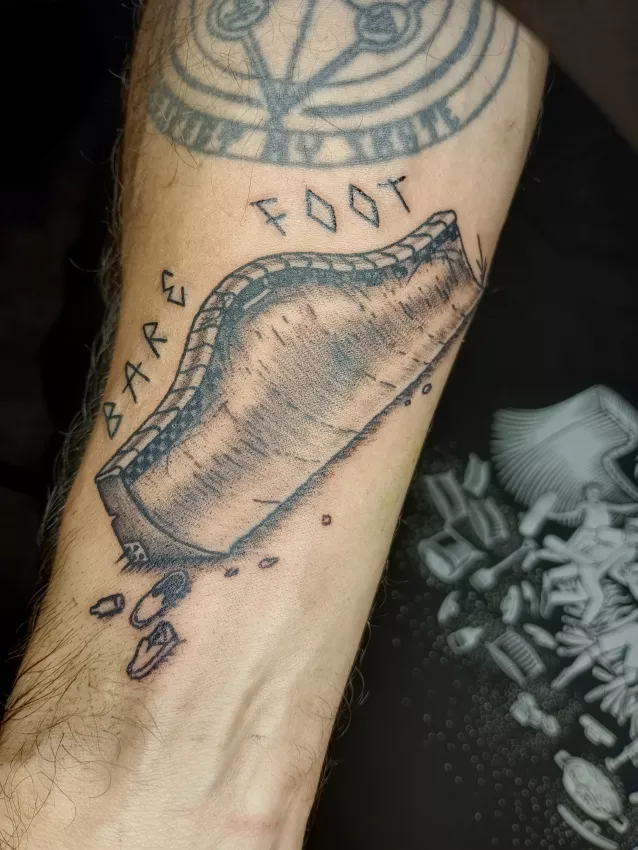
Today, Peulin is an illustrator and tattoo artist.
And her relationship with the school isn't just black or white. She keeps things. Reflexes. A structure. A rigor of the eye.
"I keep some academic reflexes, but I try to unlearn them."
That sentence is beautiful because it captures the double movement so well.
Technical training leaves you with tools. It teaches you to see. To correct. To construct. Not to panic in front of a complex shape. That's not nothing.
But it can also leave a little inner police officer. The one that says: "it's not finished," "it's not clean enough," "it's not legitimate," "it's not real drawing," "it's not worth showing."
So Peulin tries to find something else:
"I want to do everything at once, scribble in notebooks, and call my drawings finished when I decide they are."
Maybe that's what comes after school.
Relearning to finish without asking for permission. Relearning to draw ugly if you want to. Relearning that pleasure isn't a decorative bonus — it's part of the engine.
In tattooing, this question gets even more interesting. Because the drawing leaves the paper. It goes onto someone. It becomes skin, memory, gesture, relationship. You're no longer just in the academic exercise. You're in something alive, with its imperfections, its constraints, its intimacy.
And maybe that forces you to unlearn some of the control.
So, is Émile-Cohl overrated?
The short answer: it depends on what you expect from it.
If you're looking for a school that provides solid academic drawing training, Émile-Cohl has real arguments. Its technical foundation is recognized, its programs are structured, certain certifications are registered or approved by the state, and the school is an established player in the image-industry landscape.
If you're looking for a gentle, open, experimental space where you'll peacefully find your style while being supported through your existential doubts like in an indie movie with lots of wool sweaters — that may not be what Peulin experienced.
And that's where her account matters.
It's not meant to say "don't go there." It's meant to say "don't go in blind."
Go to open houses. Look at graduation portfolios. Ask for the total cost. Ask about job placement rates. Ask how many students drop out. Talk to alumni. Ask how the school supports struggling students. Ask if you'll have time to experiment. Ask if you really want five years of that model.
And above all: don't confuse prestige with permission.
A school can teach you to draw. It can give you a framework, discipline, connections, a method. But it can't decide for you what you want to do with your own hand.
At some point, you have to pick up the pencil.
Even if it shakes a little.
Key takeaways
- Émile-Cohl is a school recognized for its technical rigor and academic drawing instruction.
- Peulin's account highlights a gap between learning to draw well and finding your artistic identity.
- The cost of attendance is high and can create real social selection.
- Academic pressure can sometimes prevent experimentation, which is essential in art school.
- A prestigious school isn't necessarily the right fit for every profile or every project.
- When choosing an art school, look at the program, the cost, career outcomes, alumni, and the actual atmosphere.
- After a very academic training, it can be necessary to relearn how to create freely.
Sources
- École Émile-Cohl, Official website
- France Compétences, RNCP40341, DIPLOVIS Dessinateur praticien
- Gobelins Paris, Animation Career Review 2026 Ranking
- Le Carnet Digital, "7 conseils pour un futur étudiant en école d'art"
Go further
- Follow the artist on Instagram.
- For more details and to listen to the full episode, check out "Cellophane et Vaseline" on YouTube.
- Follow us on Instagram: @cellophane.et.vaseline