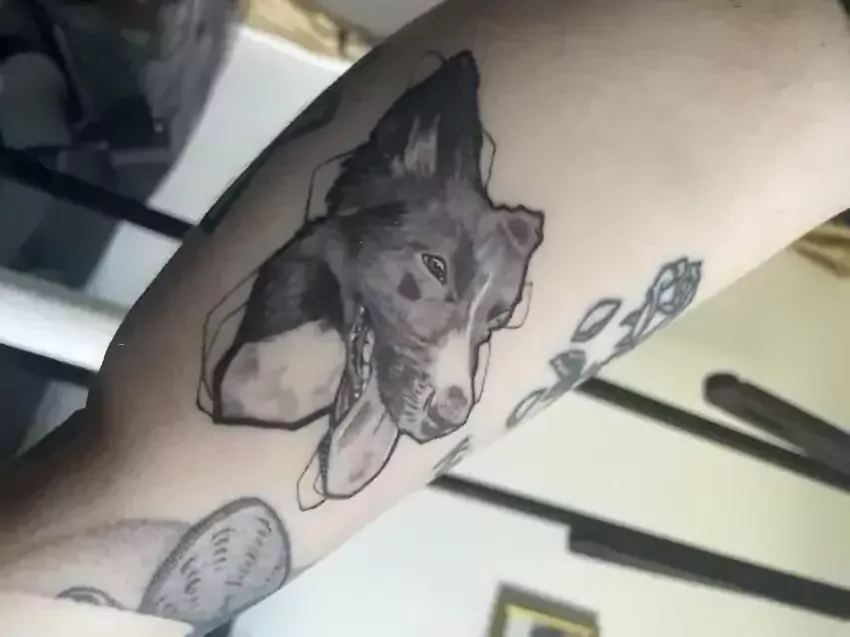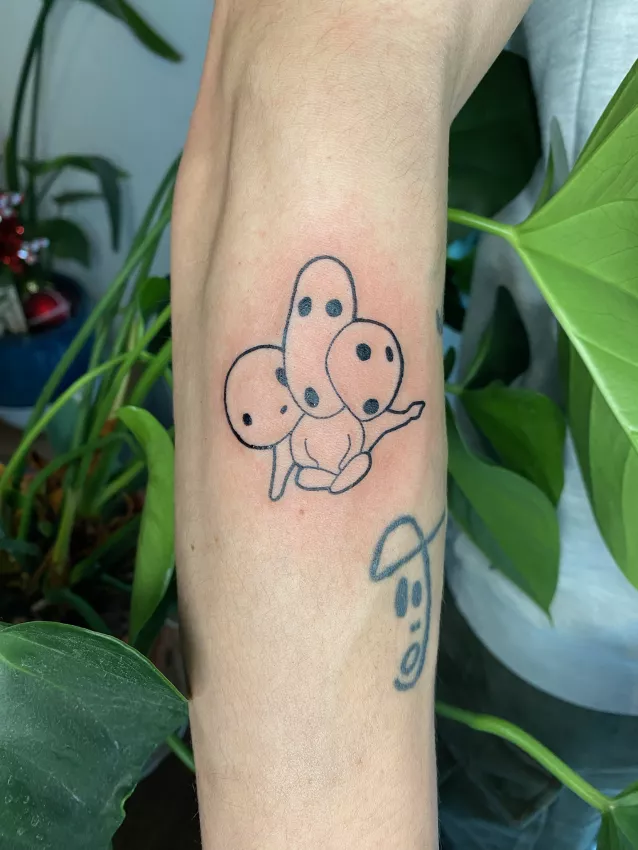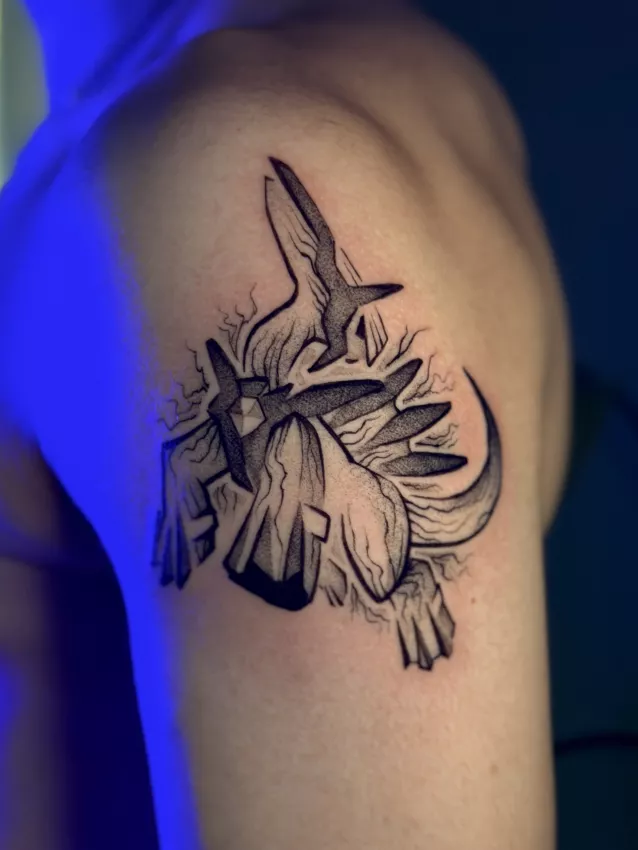
Some requests start with an image.
And then some start with a wall of text.
A proper wall. The kind of message where you can feel the person read it three times, deleted two sentences, added “sorry this is long”, then sent it anyway. Often, that is where it gets interesting.
Because a personal tattoo is not always “I want a symbol”.
Sometimes it is: “I went through this”, “I want to mark a stage”, “I want to take back a part of my body”, “I want something that reminds me without explaining everything”.
And that is where the work really starts. Not with the needle. With sorting.
Not everything has to be inside the tattoo
That is the first trap.
When a story is strong, we sometimes want to put everything in it: the date, the animal, the flower, the first name, the sentence, the astrological symbol, the place, the favorite color, the tiny detail nobody understands but that is “very important”.
After a while, the tattoo becomes an overstuffed carry-on bag. You sit on it to close it, but you know perfectly well one zipper is going to die.
A good personal project does not necessarily contain the whole story.
It keeps a tension. An image. A feeling. One detail that lands right.
The tattoo does not need to be an instruction manual. It does not need to convince the cousin who asks “but what does it mean?” at a family meal. First of all, the cousin can eat his salad.
The obvious symbol is not always the strongest one
A butterfly for transformation. A phoenix for rebirth. A rose for love. A compass to find yourself again.
None of that is forbidden. Classic symbols exist because they work.
But sometimes they are used so much that they lose a bit of flesh.
The real question is: what, inside your story, belongs only to you?
Not necessarily a big symbol. It can be an ordinary object. A texture. A plant. A word. A posture. A shape. A scene. A private joke.
A toaster can be more moving than a phoenix, if it is the right toaster. I did not think I would write that sentence one day. But here we are.
You have to think about the body, not only the idea
An idea can be beautiful in your head and work badly on skin.
The body has curves, tension, areas that move, places that age differently. A personal project has to be designed for its placement.
A long sentence on a small area can become unreadable. A design with too much detail can disappear. A symbol that is too small can age badly. A placement that is too visible can become heavy to wear.
The artist’s role is also to bring the idea back into the real world. Not to break it. To help it survive.
If you are still at the reference stage, the article on how to communicate your project can help you avoid drowning the artist under thirty screenshots that contradict each other.
Talking with the artist helps remove the overflow
Some projects completely change through conversation.
You arrive with five ideas. We talk. We remove things. We move things around. We understand that the important part was not the one you thought it was.
It is a bit like emptying a bag after a festival. At first, you think everything is necessary. Then you find three tickets, a wet sock, an emotional pebble, and you realize it needs sorting.
The tattoo artist is not a therapist. Important.
But they can help turn a story into a shape. Find distance. Avoid a tattoo that is too literal, too loaded, or too designed to be understood by other people.
A personal tattoo does not need to be readable by everyone. It needs to feel right for you.
Custom work takes time
We sometimes imagine the drawing as a small magical moment.
The person reads your story, closes their eyes, drinks an herbal tea, and boom: masterpiece.
Sometimes, yes, something comes quickly. An obvious image. A sentence. A composition that stands on its own in twenty minutes. It is rare, but it exists, and it is pretty beautiful when it happens.
Often, it is slower.
You have to read, reread, let it sit, remove, test, see whether it holds on skin, check the size, choose typography, density, breathing room.
That is why the price of a personal project cannot always be compared to a small flash design that is already ready. There is invisible time involved. We talk about that in the article on why we do not make free drawings.
Be careful with the magical bandage tattoo
I am going to be a bit annoying.
A tattoo can help mark a stage. It can be powerful. It can bring a feeling of taking back control, of choice, of recovering a body.
But it does not fix everything.
It is not therapy in black and grey. It is not a reset button. It is not a guarantee that tomorrow will be better.
And sometimes, it is better to wait.
Wait until the story settles. Until the idea stays. Until the symbol is not just an emergency. Until the body is ready.
If the project involves a scar, a medical period, pregnancy, a major body change, or fragile skin, you also need to check the right timing. The aftercare page gives the basics for healing, but medical advice may be necessary depending on the context.
Key takeaways
- A personal tattoo does not need to tell the whole story.
- The most obvious symbol is not always the right one.
- The body also decides: size, placement, aging.
- Discussion helps sort things out.
- A tattoo can mark a stage, not replace everything else.
I think the best personal projects do not say everything.
They keep a blurry zone. A breath. A place where the story can keep changing.
Because you will change too.
If you have a story and you do not yet know what to do with it, you can send it to us with what you want to keep, what you want to avoid, and the place on the body you imagine.
We do not promise to turn every wall of text into a masterpiece.
Sources
- Tattoos as a window to the psyche, PMC: https://pmc.ncbi.nlm.nih.gov/articles/PMC5632599/
- French Public Health Code, tattooing by skin penetration and piercing: https://www.legifrance.gouv.fr/codes/section_lc/LEGITEXT000006072665/LEGISCTA000018150106/
- A day with a tattoo artist! - YouTube: https://www.youtube.com/watch?v=HAU6416Qwwg