A guy comes to see me. Athletic. Wants a chest tattoo. A stunning project, detailed, hours of work.
I ask him: "How many kilos of muscle are you planning to gain in the next two years?"
He looks at me, surprised. "Well, I bulk and cut — not sure exactly. Ten kilos?"
I told him we might need to adapt the design. Because the chest of a guy at 75kg and the same guy at 85kg — not the same canvas.
He left a bit disappointed. But I'd rather that than seeing him in three years with a warped tattoo.
What Happens When You Gain Muscle
Imagine a balloon with a smiley drawn on it. You blow it up: the smiley stretches. You deflate it: it shrinks back, but never to its exact original shape.
Your skin is a bit like that. Except it's elastic. But not infinitely.
When you gain muscle, your skin stretches over the growing area. A tattoo on the bicep, shoulders, pecs, or thighs follows the movement. If the gain is gradual (a few kilos over a year), the skin has time to adapt, and the tattoo deforms less. If you go from 70 to 85kg in six months with an intense program, the distortion will be more noticeable.
Straight lines can become slightly curved. Circles can ovalize. Symmetrical motifs can lose their balance.
But the real drama is the cut.
Cutting: Worse Than Bulking
I've seen gorgeous tattoos done during a bulk, when the guy was at full volume. The tattoo was stretched, perfect.
Then he cut. Lost five kilos of fat and two kilos of water. And the tattoo — poor thing — shrunk like an old sock.
Lines got closer together. Skin spaces wrinkled slightly. Some designs relying on anatomical landmarks (the curve of the shoulder, the middle of the pec) ended up misaligned.
It's not systematic. But the bigger the tattoo, the more the area is subject to volume changes, the higher the risk.
Weight Loss: A Different Story
If you lose a lot of weight (20-30kg or more), the tattoo follows the shrinking skin. The outcome depends on your age (younger skin retracts better), the area (the belly is more affected than the forearm), and the speed of loss.
Sometimes the result is a bit wrinkled, a bit distorted. Sometimes it's imperceptible.
A client lost 40kg. Her forearm tattoo: perfect. Her belly tattoo — a beautiful mandala — distorted a bit. We touched it up. No big deal.
But if I'd known she was going to lose that much, I might have placed the mandala differently.
The Most Stable Areas (and the Riskiest)
Some areas barely move even with weight changes:
- Forearm: very stable. Low volume variation. That's why it's such a versatile spot — I cover it in my article on forearm tattoos.
- Shin, ankle, malleolus: thin skin, not very stretchy. Tattoos there stay stable.
- Back: fairly stable, especially the upper back. The lower back can move with weight, but less than the belly.
- Ribs: stable too, but painful.
Risk areas:
- Belly and waist: the distortion champions. Weight gain, pregnancy, weight loss — it all shows.
- Biceps and shoulders: very sensitive to muscle gain.
- Chest (pecs, breasts): moves with muscle volume and weight changes.
- Glutes and thighs: fat storage areas, so sensitive to variation.
- Inner arm: thinner skin, variations show more.
If you want a big project on a stable area, the back — especially the upper back and shoulder blades — is an excellent choice. I wrote an article on the giant back tattoo canvas.
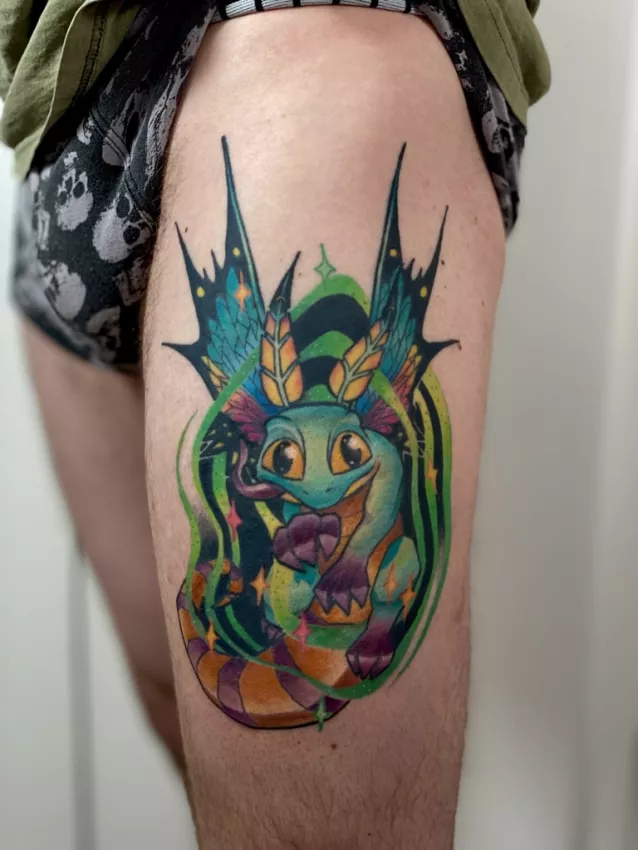
The thigh is a good compromise: it can move a bit, but if the design is well thought out, it works fine. I detail this in my article on thigh and leg tattoos.
What I Advise My Athletic Clients
If you lift or plan significant weight loss:
- Stabilize first. If possible, reach your target weight before starting a big project on a sensitive area.
- Tell your artist. Be honest: "I plan to gain X kilos / lose Y kg in the coming months." They can adapt the design.
- Avoid hyper-rigid motifs. Perfect circles, absolute symmetry, parallel lines — these betray distortion first.
- Prefer organic compositions. Designs that follow the body's natural curves — floral, adapted tribal, free forms — handle variations better.
- Plan for a potential touch-up. Not a failure. Just life.
The Takeaway
Your body changes. That's normal. Your tattoo will change with it. The goal isn't to freeze a perfect moment of your body — it's to have a tattoo that moves through these changes with grace.
Because even if your tattoo distorts a bit on a bicep that grew five centimeters, it's still your tattoo. And the only person who'll notice the difference is you.
If you really want a perfectly symmetrical tattoo on an area that moves, we can do it. But I'll have warned you. And ten years from now, when you look at your tattoo wondering "was it always like this?" — you can't say you didn't know.