The first time someone comes to the studio for a first tattoo, there is often that very recognizable little mix.
A phone in hand. A Pinterest screenshot. Three possible sizes. A sentence like: “I don't know if this is a stupid question, but...”
First: no.
In tattooing, stupid questions are often the questions that prevent bad tattoos. So we like them. They take up space, like an old Ikea cabinet in a hallway, but they are useful.
A first tattoo is not just choosing a drawing. It is choosing a place on your body, a size, a style, a person you are going to let near you with a needle, and a mark that will stay there for a while. Normally, for life. Light mood, casual Tuesday.
Choose the style before choosing “a tattoo artist”
This is often where things start going sideways.
Someone looks for a tattoo artist in Grenoble, finds a studio, sends an image, and hopes anyone can do the project.
Except no.
A tattoo artist is not a printer with rings and tendinitis. Every artist has a hand. Obsessions. Comfort zones. Things they love doing, and things they can do but that will give them the energy of a sad toaster.
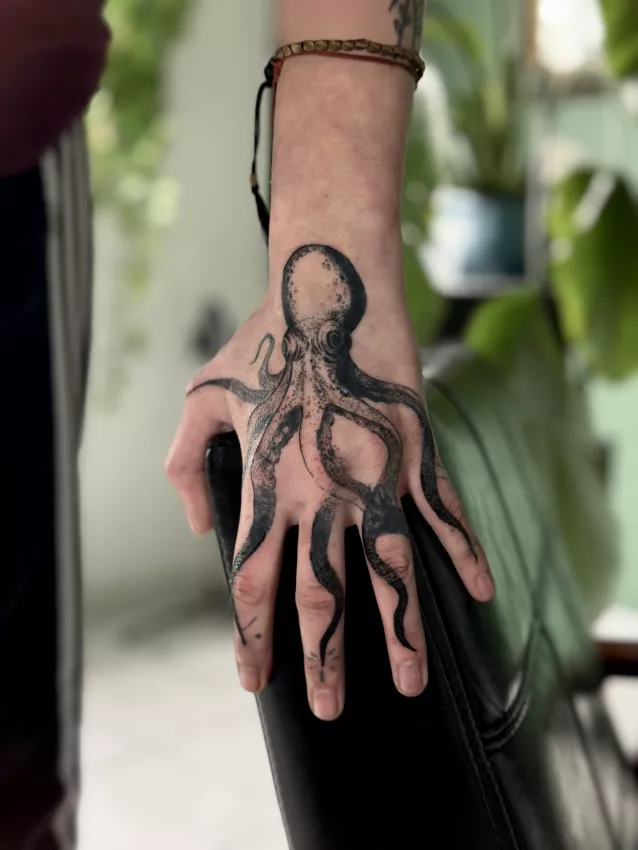
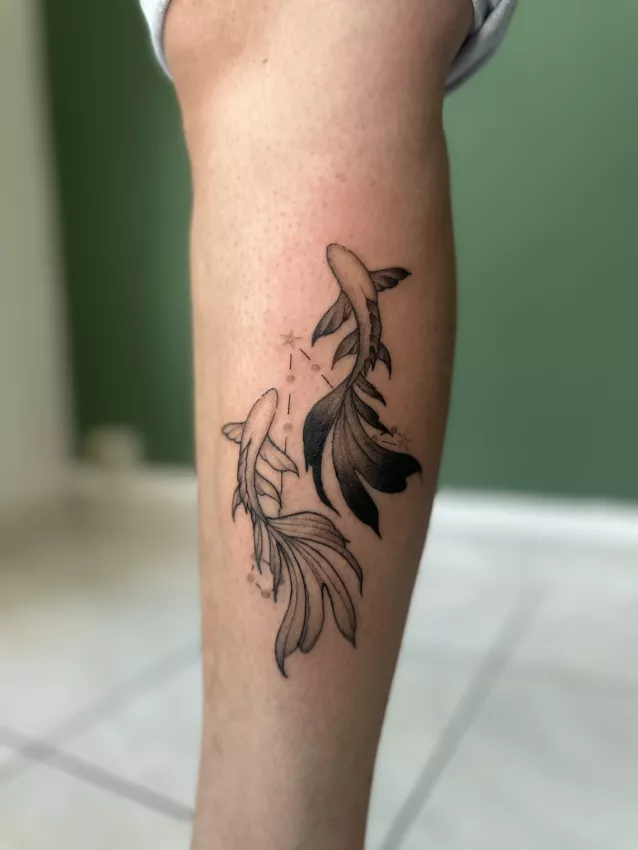
If you want engraving-style work, go see someone who does engraving-style work. If you want fine floral, go see someone who does fine floral. If you want a big brutal black lettering piece, do not go to the person who only posts clean-line butterflies.
A good first reflex: look at healed tattoos when there are some, placements, sizes, lines, similar projects. Not to copy. To understand whether the artist's world fits your idea.
At Studio Pixel, you can already look at the artists. This is not a formality. It is often where the project starts becoming clearer.
Size and placement are not details
A tattoo that is too small can look cute on day one.
Then three years later, it becomes lukewarm soup.
Lines live. Skin moves. Ink settles, spreads a little, ages. A design full of micro-details over two centimeters can look beautiful on a screen, but less funny on a real body that sweats, tans, heals, rubs against jeans and forgets to apply cream.
Placement matters too.
An arm, a thigh, ribs, an ankle, fingers: not the same pain, not the same hold over time, not the same constraints.
For a first tattoo, I often recommend choosing an area that is fairly easy to live with. Not necessarily hidden. Not necessarily tiny. Just an area where you can breathe during the session and heal properly afterwards.
If you are still hesitating about the design, the article on choosing your first tattoo without panicking can help you sort things out without turning your brain into an infinite Pinterest tab.
The stencil is the moment to speak up
The stencil is the transfer we place on the skin before tattooing.
That is when you see the real size. The real placement. The effect in the mirror. The way the design sits on your body. And sometimes, that is when you realize that what you had imagined in your head does not work exactly the same way on your skin.
And that is normal.
You can say: “can I see it a bit smaller?”, “can we try it a little higher?”, “I think I prefer the other version”, “actually, I'm not sure”.
It is your body. Not a Deliveroo order you validate too fast because you are hungry.
A tattoo artist should not pressure you at that moment. If you do not feel the placement, say it. If you need to look again, look again. If you need to postpone, yes, it is annoying for the schedule. But it is less annoying than wearing a tattoo you did not really choose.
Does a first tattoo hurt?
Yes. No. It depends. Classic tattooed-Norman answer.
Pain depends on the area, the type of tattoo, your fatigue, your stress, your sensitivity, and the duration. A small fine line on the forearm has nothing to do with a large black fill on the ribs.
The most important things: come rested, eat before, drink water, avoid alcohol and substances, wear practical clothing, and say something if you do not feel well. And if you need a break, say it.
This is not a dermograph version of Survivor.
You can also read the studio FAQ. Not to learn your future tattoo by heart. Just to avoid arriving with six tiny stresses that are easy to defuse.
Hygiene should be clear, not magical
In a serious studio, needles and cartridges are sterile and single-use. The station is protected. Surfaces are prepared. The process avoids cross-contamination.
Not everything is “sterile” in the operating-room sense, and that is exactly why precision matters. Tattooing is not surgery, but it is not a sticker workshop either.
You have the right to ask questions. A good studio would rather answer those questions a thousand times than let you leave with a doubt.
To go deeper, there is already a full article on tattoo hygiene.
After the session, the tattoo is still working
The tattoo is not finished when you leave the studio.
The skin has to heal. And the first month matters a lot.
Aftercare depends on the type of tattoo, the area, the skin, and the amount of fill. A fine line does not behave like a large black fill. A thigh does not live like a finger. A full back does not need the same attention as a small symbol on the arm.
For detailed instructions, follow the tattoo aftercare page and the guidance given for your project. If something seems abnormal — strong pain, redness spreading, heat, pus, fever — get medical advice. Not a TikTok poll.
Key things to remember
- Choose an artist for their style, not just because they are available.
- Keep the size readable. Skin is not a Retina screen.
- The stencil is the moment to speak up, not to pretend.
- Eat, sleep, hydrate, and say something if you do not feel well.
- Aftercare is part of the tattoo.
Hesitating is not a problem. Even better: hesitating a little is often healthy.
What is dangerous is wanting to go too fast because you already booked the date, because you want to please someone, or because your brain decided that “now that we are here, we have to do it”.
If you want to prepare a first tattoo in Grenoble, send your idea, your references, the area, the approximate size, and what you want it to say. We will look at whether it makes sense, which artist can do it, and how to avoid turning a good idea into a portable mini-regret.
And if you do not know exactly what you want yet, maybe that is also the beginning of the project.
Sources
- Order of March 11, 2009 on good hygiene and sanitation practices: https://www.legifrance.gouv.fr/loda/id/JORFTEXT000020414235
- French Public Health Code, tattooing by skin penetration and piercing: https://www.legifrance.gouv.fr/codes/section_lc/LEGITEXT000006072665/LEGISCTA000018150106/
- A day with a tattoo artist! - YouTube: https://www.youtube.com/watch?v=HAU6416Qwwg