Blackwork doesn't fake it. It's black, graphic, sometimes massive, sometimes very fine, but rarely lukewarm. Blackout goes all the way: large areas filled with black ink, sometimes to cover old tattoos, sometimes to completely transform an arm, a leg, or a body part.
At the studio, this style usually triggers two reactions. Either "that's beautiful." Or "why would you paint everything black?" Both reactions are useful. They remind you that this isn't a light decorative choice. It's a silhouette decision.
Blackwork and blackout: not the same thing
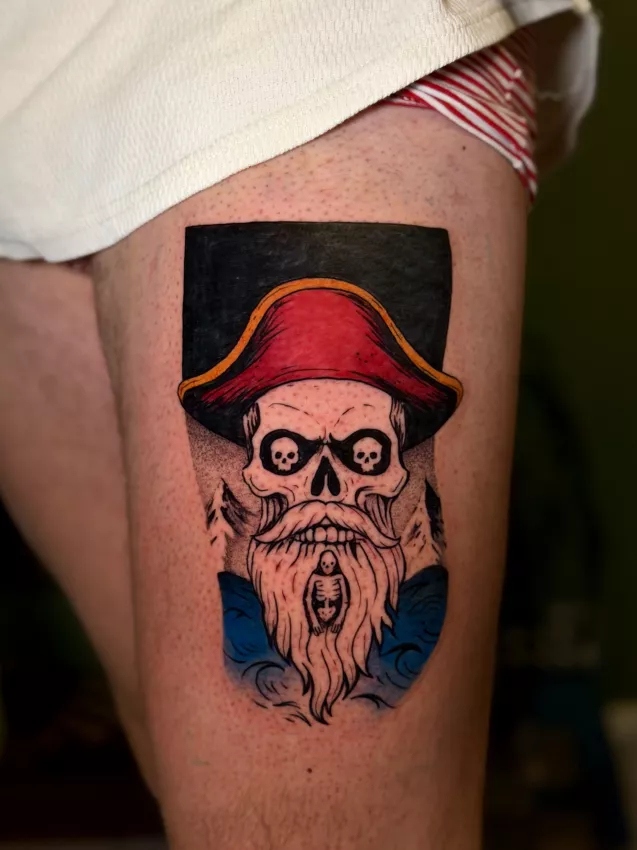
Blackwork refers to a tattoo built mainly with black ink. It can be ornamental, contemporary tribal, geometric, organic, abstract, illustrative, dotwork, engraving, or brutalist. Black dominates, but it isn't necessarily solid everywhere.
Blackout is more radical: large saturated black surfaces. Forearm, full sleeve, leg, shoulder, chest. It can be an aesthetic gesture or a cover-up solution to hide old tattoos.
A blackwork piece can be delicate. A blackout, rarely. It can be elegant, yes. Subtle, sometimes. Discreet, no. Even with a lot of imagination.
Why choose mass black?
Black gives immediate presence. It transforms the silhouette. It can make a body more graphic, almost sculptural. For some people, that's exactly the point: less a motif than a mass, an architecture.
It can also be about turning a page. A lot of blackout projects start with old tattoos the person doesn't want to see anymore. In that case, stay clear-headed: black covers, but it also imposes a new constraint.
The FAQ explains cover-up basics: a cover-up often needs a larger, darker piece, and sometimes partial laser removal beforehand. Blackout is an extreme option, not an "undo" button.
Pain, time, and fatigue
Large black fills are physical. They can sting hard, for a long time, with many passes over the same area. The packing work needs consistency. The skin heats up. The body gets tired.
On a small blackwork piece, it's still manageable. On a blackout, we're usually talking about several sessions. You need to plan recovery, work, clothes, friction, and sleep. This isn't the ideal project to squeeze between two chaotic weeks.
Pain depends on the area too. Outer arm, calf, thigh: usually more bearable. Elbow, knee, ribs, inner arm: less fun. The body has its own sense of humor.
Healing a large black solid
A large solid needs to heal cleanly. It can ooze more, feel tighter, and show visible dead skin. Follow the aftercare calmly: gentle washing, clean drying, light cream if needed, no baths, no intense sport, no sun.
Don't scratch. Don't panic at every flake. Don't decide on day four that it's ruined because your skin looks like a wet old poster. Healing goes through ugly phases. That's normal.
Touch-ups are possible, sometimes necessary on very dense solids. The black should be even, but skin isn't a printer.
Risks and black inks
Black inks are very common, but they don't make the tattoo "risk-free." Medical studies remind us that tattoos can cause skin reactions, inflammatory or allergic, even if they're still rare: Cutaneous Adverse Reactions Associated with Tattoos.
For a large blackout, the amount of ink and the surface worked make seriousness even more important. Hygiene, equipment, rest, follow-up: don't treat it like a five-centimeter flash.
If you have dermatological history, strange reactions to past tattoos, or medical doubts, mention it ahead of time. Not when the needle is already loaded.
Blackwork, organic, neo-tribal
Blackwork can be very contemporary. Organic shapes, motifs that follow the muscles, thick lines, negative space, abstract compositions. Neo-tribal is coming back too, with a less copied take on 2000s tribal and more thought put into how it sits on the body.
Good blackwork uses empty skin just as much as black. Breathing room prevents the blocky effect without intention. A solid fill can be powerful, but a well-cut shape often hits harder.
You also need to think about visual rhythm. A fully black arm can be strong, but an arm with breaks, cutouts, windows of skin, and density variations can tell more. Black doesn't have to cover everything to dominate.
Before finalizing a project, I recommend looking at the whole body, not just the zone. A forearm blackout changes how the hand, elbow, upper arm, and even clothes read. It's not just a tattoo. It's a silhouette change.
What I'd keep in mind
- Blackwork doesn't always mean blackout.
- Blackout is radical, sometimes useful as a cover-up, never trivial.
- Large solids need time, pain, and serious healing.
- Think about black alongside empty space.
- Recommended cover: blackwork arm with negative shapes, natural light, 1200x630 format.
Blackwork is strong when it knows why it's taking up space. Otherwise, it's just a lot of black and a lot of courage for not much. Which is an expensive combination.