Minimalist tattoos are often the entry point. A small star. A word. A line. A date. A discreet symbol "to start." I get it. You want something light, not too committing, almost secret. A tattoo that doesn't shout in the street.
But minimalism has a problem: it looks easy. And when something looks easy, everyone underestimates the work behind it. A small tattoo, especially in Grenoble where many people want their first discreet piece, demands real precision.
Minimalism doesn't forgive much. There's no dramatic shading to hide a mediocre line. No grand composition to balance a botched detail. Just the design. Naked. Right there. Nice, but unforgiving.
Minimalist doesn't mean simplistic
A good minimalist tattoo removes the excess. It doesn't remove the thinking.
You need to choose what stays. A line instead of a full outline. A silhouette instead of a detailed drawing. A word instead of a sentence. A sign instead of an entire story. It's reduction work.
The trap is wanting to fit too much intention into too little space. Three symbols, a date, a flower, an initial, a small sun, "but very discreet." At some point, it's not minimalist anymore. It's an emotional junk drawer.
A minimalist tattooer must know how to say: "we keep this, we drop that." Not to impoverish your idea, but to give it a clear form.
If you want to dig into this, the article minimalist tattoo: small doesn't mean simple goes exactly in that direction.
Precision depends on size
Size is a sensitive topic. Many people come in showing two centimeters between their fingers. "I want this, roughly." And often the honest answer is: "not if you want it to stay readable."
Skin isn't paper. A tattooed line can spread slightly over time. Very close details can merge. Small gaps can disappear. Tiny letters can get blurry.
Enlarging a minimalist tattoo doesn't mean making it huge. It means giving it enough room to age properly.
A small simple heart can stay small. A word with fine typography needs a minimum size. A mini flower with several petals needs breathing room. A constellation with dots too close together can become a confused little speck.
Precision isn't just the tattooer's hand. It's also choosing a realistic size.
Placement can make or break the project
A minimalist tattoo is often noticed for its placement. Because the design is discreet, placement becomes almost half the design.
Wrist, ankle, forearm, ribs, nape, collarbone, back of arm, fingers. Each area says something. Each area also ages differently.
Fingers, for example, attract a lot. Visible, fine, cool, almost jewelry. But it's also a complicated area. Longevity can be less stable, touch-ups more likely, results more unpredictable. Same for some high-friction areas.
A good tattooer should explain the advantages and limits of placement. Not just follow your idea in silence.
For a first project, you can also read first tattoo in Grenoble, especially if you're unsure about the zone.
Minimalist lettering needs special attention
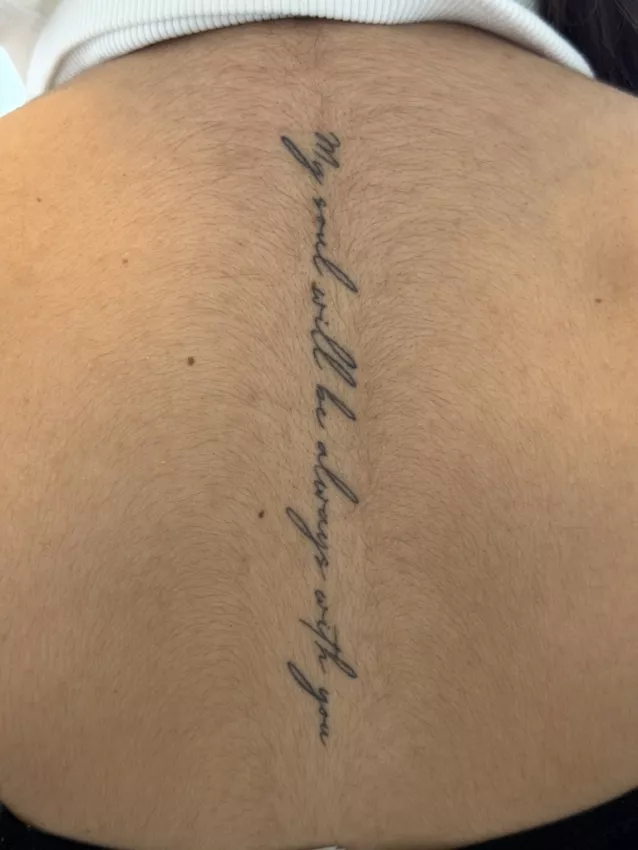
Words carry a particular power. A name, a short phrase, a date, handwriting. People think it's simple because it's "just letters." It's not.
A line that's too thin may not hold. Typography too tight can close up. Handwriting too small can become illegible. Accents, spacing, heights, curves: everything matters.
You also need to think about meaning over time. Not dramatically. But a tattooed word needs to be wearable long-term. A phrase that feels profound at 22 can become a fridge magnet at 35. It happens. Life is cruel to our quotes.
The studio's job isn't to judge your text, but to check it's tattooable, readable, well-placed, and correctly spelled. Yes, we check the accents. Yes, it matters.
The price of a small tattoo sometimes surprises
"But it's so small." Famous line.
A small tattoo still requires an exchange, preparation, sterile equipment, a station, time, concentration, setup, advice, sometimes a custom drawing. The minimum cost of a tattoo doesn't depend only on centimeters.
A three-minute design almost never exists in real studio life. There's everything around it.
That's why a minimalist tattoo can seem expensive for its size. In reality, you're not paying for surface area. You're paying for a complete, clean, precise act.
The article tattoo pricing: why it varies explains this logic well.
Minimalist doesn't mean without personality
Minimalism can quickly fall into a catalog. Little moon, little lightning bolt, little heart, little wave, little butterfly. Nothing wrong with these motifs. But if you want something more personal, you need an angle.
A line inspired by a place. A simplified shape of an object. A flower reduced to its silhouette. A redrawn symbol. A very sober composition thought for a specific area.
Minimalism works better when it's right than when it's original at any cost. No need to invent an incomprehensible symbol if a simple form says things better. But avoiding copy-paste still matters.
Choosing a minimalist tattoo artist in Grenoble
Look at line consistency. Small letterings. Healed results if available. Placements. The ability to say no to a size too small. Clarity of advice.
At Studio Pixel, we like small tattoos when they're treated with the same seriousness as large ones. Not with more drama. Just with respect. A two-centimeter piece can be very important to someone. And technically, it can demand more calm than a much larger motif.
A successful minimalist tattoo is one that seems obvious in hindsight. Like it was always meant to be there. To reach that obviousness, you often need to remove, adjust, enlarge a little, shift a little. In short: work.
Small tattoo, big precision. Less catchy than a zen slogan, but more true.