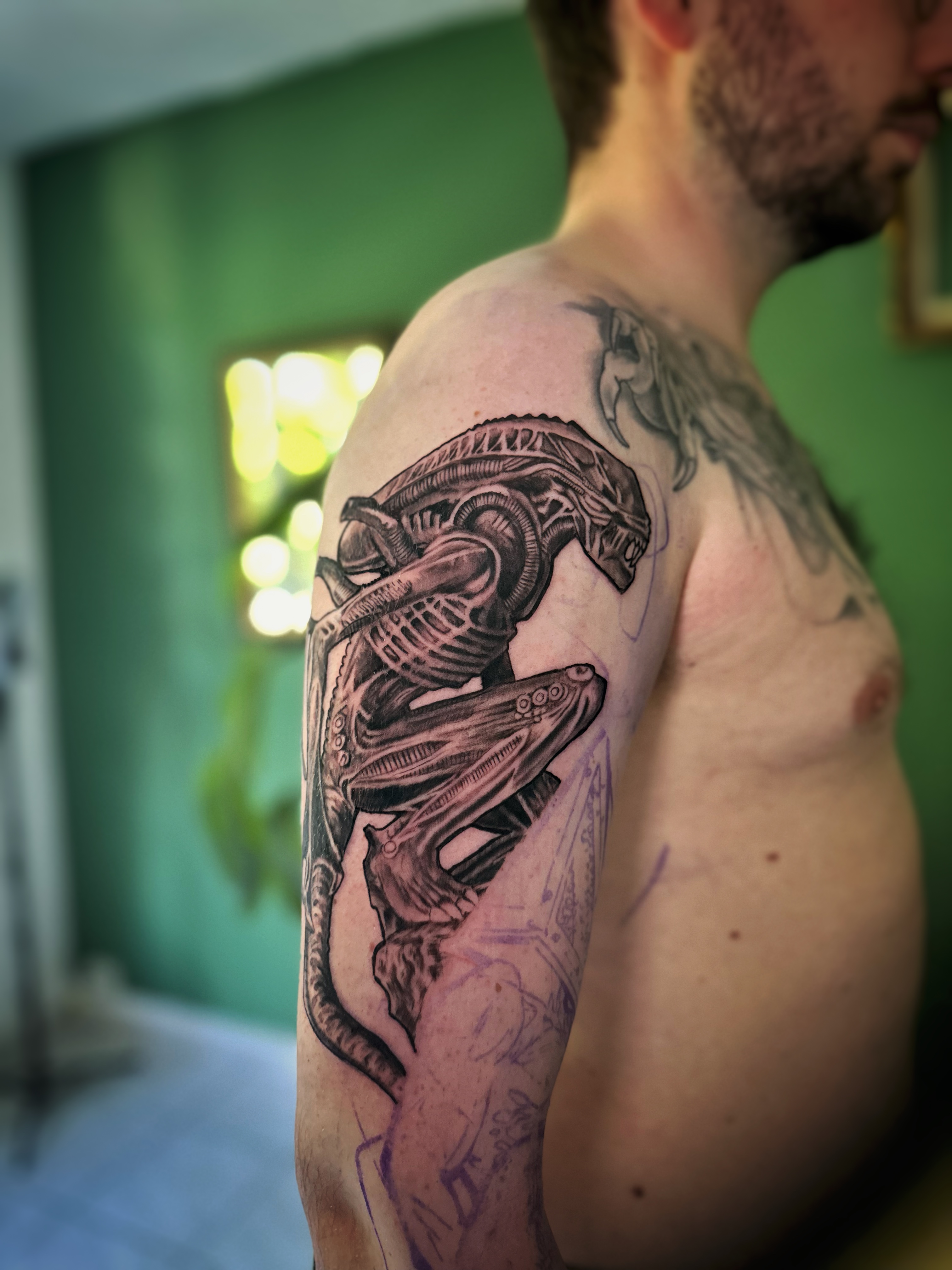
Last night, a client messaged me at 10PM. She had an MRI scheduled in a week, and her doctor just asked: "Do you have tattoos?" Panic. She asked if she'd have to cancel, if the ink would heat up, if she risked second-degree burns.
I told her: "Breathe. Let's put this in perspective."
Because this question comes up all the time, and the answers you find online are either too alarmist or too vague.
The Real Risk: Metal Salts in Ink
An MRI is a giant magnet. Very powerful. It creates an intense magnetic field (1.5 to 3 Tesla typically — for context, Earth's magnetic field is about 50 microteslas). This field interacts with certain metals.
The issue comes from pigments containing metal oxides:
- Iron oxide (found in some blacks, browns, reds)
- Titanium dioxide (white, but used to mute colors)
- Chromium oxide (green)
- Cobalt oxide (blue)
- Cadmium sulfide (yellow, red)
When these particles are exposed to an MRI's magnetic field, they can:
- Heat up — metal particles align with the field and vibrate, generating heat
- Create artifacts — distortions on the image that hide the area around the tattoo
- Cause irritation — in very rare cases, swelling or a pulling sensation
Before you freak out, let's look at the actual numbers.
What the Studies Say
Several studies have looked into this. The most cited one: a 2022 review in the American Journal of Roentgenology analyzing 330 cases of tattooed patients undergoing MRIs.
The results:
- 0.005% of patients reported tattoo-related complications (heat, redness)
- No serious burns reported
- All complications were reversible within hours
- Artifacts mainly affected tattoos with red, dark brown, and yellow ink
In 2024, a French study of 15,000 patients in Île-de-France confirmed: the risk of skin complications is below 0.03%. That's comparable to an allergic reaction to a band-aid.
Radiology (2023) adds that tattoos done after 2010 with REACH-compliant inks (free of banned heavy metals) have an even lower risk — close to zero.
When You Should Be Careful
Some situations still deserve extra attention:
Very dense black tattoos. Modern carbon blacks are rarely an issue, but some older blacks contained iron oxide. If your tattoo is over 15 years old, it might contain pigments we don't use anymore.
Reds, browns, and yellows. These are the colors most often associated with MRI artifacts. Red (iron oxide, PR101 pigment) is the most cited in the literature. If your MRI targets an area near a dense red tattoo, tell the radiographer.
Dark tattoos on the chest or abdomen. If the MRI is scanning your heart or lungs, a large black or red tattoo on your torso can interfere with image readability.
White tattoos. Titanium dioxide (TiO₂) is magnetically inert, so no danger. But it can still produce artifacts on T1-weighted sequences.
Tattoos That Are ABSOLUTELY Fine
The vast majority of modern tattoos:
- European brand inks (Dynamic, Eternal, Kuro Sumi, Intenze, Solid, World Famous)
- Black or light gray tattoos
- Tattoos over 6 months old (fully healed)
- Tattoos on limbs (arms, legs) — away from the scanned area
If your tattoo is recent (under 6 months), it may be slightly more heat-sensitive because the skin hasn't finished healing. But that's not dangerous — just a possible discomfort.
Precautions to Take
If you have an MRI scheduled:
- Tell the radiographer. Rule number one. They need to know where your tattoos are, their color, and how old they are. They'll adjust the protocol if needed.
- Avoid nickel patches in the days before your MRI. Some tattoos contain trace amounts of nickel (see our article on ink allergies). Under normal conditions this isn't a problem, but combined with a strong magnetic field, it can trigger a reaction.
- Report any heat sensation immediately. Normally it won't go beyond mild warmth. If you feel real heat, the radiographer can stop the scan or adjust the settings.
- Check with your doctor if you're on photosensitizing medication. Some meds (see our article on tattoos and medication) increase sensitivity to radiation. Not MRI-specific, but worth mentioning.
- Cool water rinse after the scan if you feel residual warmth — it fades in minutes.
What About Other Medical Exams?
MRI isn't the only exam that interacts with tattoos.
X-rays (standard radiology): no risk. X-rays aren't magnetic and don't interact with pigments. A very dense tattoo can slightly attenuate the image — but that's rarely an issue in practice.
CT scans: same deal. X-rays don't interact with ink. No special precautions needed.
Ultrasound: no problem. Ultrasound waves pass through ink without interaction.
Radiofrequency (some aesthetic treatments): caution. RF or laser treatments can interact with dark pigments. That's a different topic, but if you're planning an aesthetic procedure on a tattooed area, mention it.
What I Take Away From All This
I've tattooed hundreds of people. Doctors, nurses, radiographers — even a radiologist once (a small, discreet calf tattoo). None of them ever told me: "I can't get MRIs anymore."
The consensus is this: MRI remains the safest imaging method for tattooed people, as long as you inform the radiographer. The risk is statistically insignificant. Burn cases are extremely rare and almost always linked to old inks (pre-2005) or amateur tattoos using industrial pigments.
If you want a tattoo and you have regular medical checkups — including follow-up MRIs — it's not a contraindication. Pick a reputable studio, use compliant inks, and tell your medical team about your tattoos. That's it.
One Last Important Detail
If you have a black henna tattoo before an MRI, that's different. Black henna contains PPD (paraphenylenediamine), a chemical that can cause severe skin burns under MRI. If you have a temporary black henna tattoo, absolutely tell the radiographer.
For permanent tattoos with professional inks, don't panic. The risks are documented, very low, and the precautions are simple.
Sources
- Radiology (2023) — MRI Safety and Tattoos: A Systematic Review of 15,000 Patients
- American Journal of Roentgenology (2022) — Tattoo-Related Complications in MRI: Retrospective Analysis
- ANSM — Risk Assessment of Tattoo Inks in MRI, 2021 Report
- Revue Française d'Imagerie Médicale (2024) — Prospective Study of 15,000 Tattooed Patients in Île-de-France
- PubMed — MRI Safety in Patients with Tattoos: A Review of Current Evidence (2024)
- Société Française de Radiologie — Practice Guide: MRI and Tattooed Patients
- HAS — Tattooing and Medical Imaging: 2023 Recommendations