Yesterday, a guy asked me: "So, is handpoke worse?"
I looked at him. He has a tribal bracelet from 2003 going up to his elbow. I said no, it's not worse, it's just not the same thing. But his question isn't stupid. It comes up all the time. Handpoke, rotary machine, coil — it's easy to get lost.
So let me lay it out.
The first time I held a machine
Equipment, needles and what a machine actually does are naturally part of our training courses in Grenoble, with progressive practice rather than a mystical leap straight onto human skin.
I must have been 19, a friend had grabbed a cheap Chinese machine off the Internet for 40 bucks. We all know how that ends. The buzz, the vibrating needle, ink splattering everywhere. It was messy, imperfect, and yet I loved it. What I didn't know back then is that the gesture changes completely depending on the tool in your hand.
Today at Studio Pixel, I switch between several techniques. They all have their own personality. Like musical instruments. You don't play piano the same way you play guitar.
Handpoke: the original technique
Handpoke, or stick and poke for the initiated, is the original gesture. No motor, no cable. Just a needle, some ink, and your hand doing all the work. Each dot is placed one by one.
Pros: it's gentle, quiet, almost meditative. For the person being tattooed, it hurts less — well, a different kind of pain, more superficial. For fragile areas (fingers, ribs, inner arm), some swear it's more bearable.
Cons: it's slow. Very slow. A tattoo that would take one hour with a machine can take three hours handpoked. And the finish isn't the same: it stays slightly textured, a bit pointillist. It's no coincidence that handpoke is best friends with dotwork.
Want a super sharp, bold, solid black result? You're better off with a machine.
Rotary: the modern standard
Rotary machines have become the dominant tool in recent years. Why? They're versatile, relatively quiet, and offer great control.
How it works: a rotating motor moves the needle up and down. Smooth, consistent movement.
Pros: versatility. One machine can do linework, shading, and colour packing with adjustments. Quieter than coils. Lighter. More forgiving for the artist's hand on long sessions.
Cons: some artists feel the sensation is different — less "punch" than a coil. Not necessarily a problem, but a preference.
Most of the work at Studio Pixel is done with rotary machines. They're reliable, consistent, and allow precision work across styles: geometric, mandala, fine line, colour.
Coil: the veteran
Coil machines are the classic tattoo machines — the ones you see in old-school flash. Two electromagnetic coils that move the needle bar up and down.
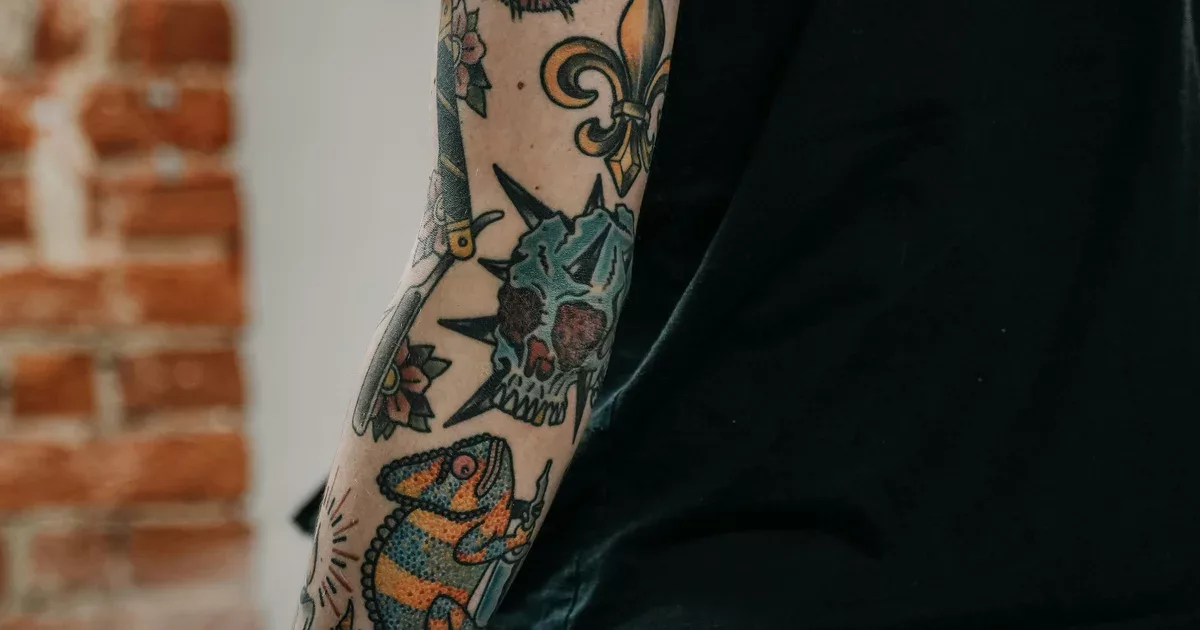
Pros: that distinctive sound. A solid, percussive feel that some artists swear by. Great for bold lines, traditional work, heavy colour saturation. Many old-school artists still use them.
Cons: heavier, louder, more vibration. Takes more skill to tune and maintain. Can be less comfortable for the artist on long sessions.
Coil machines are like manual transmission cars: less common than they used to be, but some people will never switch.
Does it change the result?
Yes and no.
A skilled artist can get a great result with any tool. The technique matters more than the equipment. But each tool has a character that influences the final outcome:
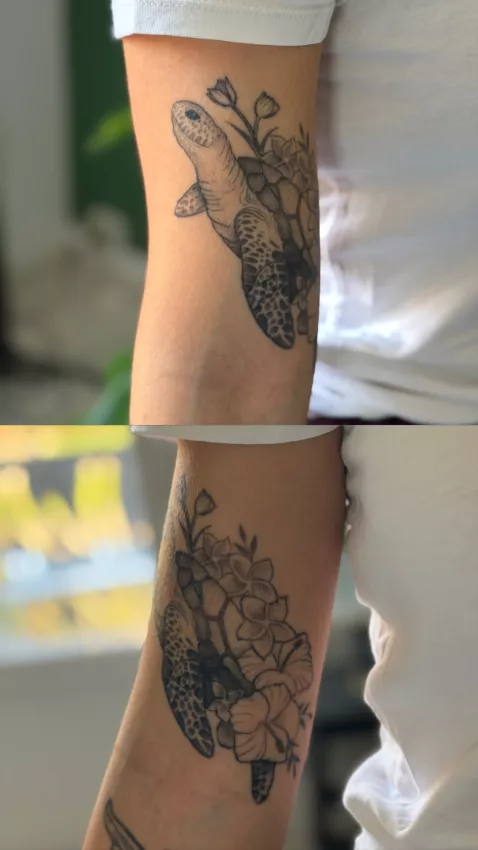
- Handpoke = textured, dotwork, organic feel. Best for simple designs, fine lines, spiritual vibe.
- Rotary = versatile, clean, precise. Best for most modern styles.
- Coil = punchy, bold, traditional. Best for old-school, heavy lines, solid colour.
Which one should you choose?
You don't need to choose. Your tattoo artist does. And most have a preferred tool they know inside out.
What matters is that the artist masters their tool. I've seen gorgeous handpoke and mediocre machine work. I've seen coil work so fine it looked like a photograph.
The tool is a means. The hand is what counts.
Preparing for your first tattoo?
Want to know more about tattoo styles? Browse the guides.
Sources
- Eaves, I. (2018). The Art of Tattooing: A Complete Guide. London: Tattoo Press.
- Serup, J., & Kluger, N. (2021). "Tattoo techniques and their impact on healing and quality." Dermatology Research and Practice, 2021, 1–8.
- Miller, J. (2020). "Rotary vs Coil: A Comparative Study of Tattoo Machine Performance." Journal of Tattoo Science, 4(2), 45–53.
- Tattoo Machine History — National Tattoo Museum Archives.
- Interviews with professional tattoo artists across France, 2023–2024.