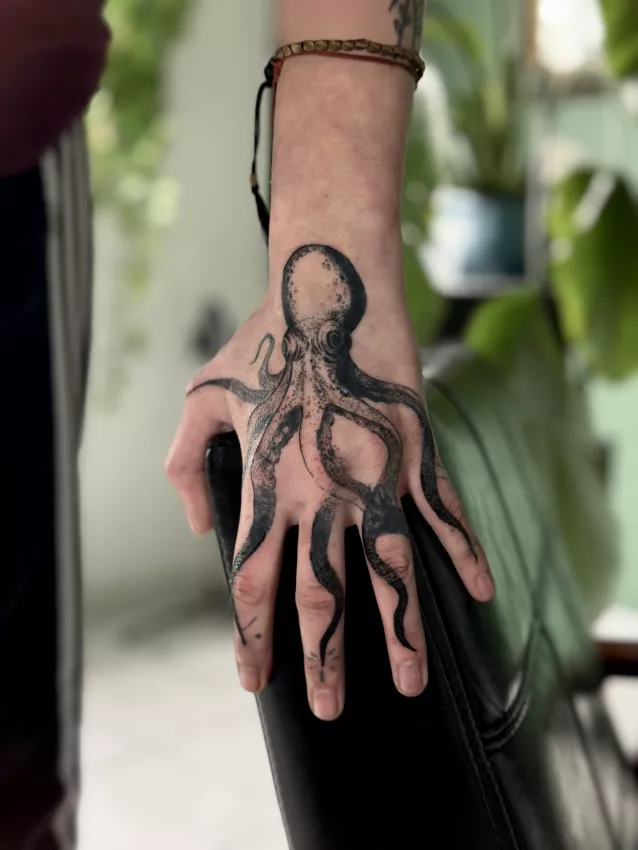
I have already seen someone walk out of the studio and ask: “Can I just go have a drink on a terrace?”
The short answer is yes.
The full answer is: yes, but not while putting your fresh tattoo in direct sun like a motorway sausage.
It is always that slightly absurd moment. We have just spent two hours doing something precise, clean, sterile, meticulous. And ten minutes later, the real threat becomes a café chair facing due south.
Life is badly designed.
Direct sun is a no during healing
A fresh tattoo is wounded skin.
I use the word “wounded” because it puts things back in place. Not to scare you. A tattoo is controlled, clean, done in good conditions. But technically, the skin has been crossed by needles.
So direct sun: avoid it.
On the Care page, we recommend avoiding direct sun for the first three weeks. That is the simple rule to remember.
The FAQ also explains that surface healing usually takes around two to three weeks, and that the skin can take up to six weeks to regenerate more deeply.
So if you want the practical answer: no direct sun for at least three weeks. And after that, serious protection.
Not “I’m just walking five minutes.” Not “I’ll hide it with my hand.” Not “I’ll put a tote bag over it but it moves every four seconds.”
A loose, clean, breathable piece of clothing is better.
Sunscreen, not on a fresh tattoo
This is the classic trap.
Sunscreen is useful. Very useful. But once the tattoo has healed.
On a fresh tattoo, you do not want to spread a product that is not made for open skin over it. Even a good sunscreen. Even organic. Even with packaging that makes you want to save dolphins.
During healing, keep care simple: gentle washing, clean drying, a thin layer of suitable cream if needed. No perfume, no aggressive products, no TikTok recipe with miracle oil.
Your tattoo does not need a twelve-step Korean skincare routine.
It mostly wants to be left alone.
Why does the sun damage a tattoo?
The sun can irritate the skin while it is healing.
It can encourage poor healing, redness, a burning feeling, drier skin, and sometimes a loss of sharpness.
And over the long term, UV rays contribute to tattoo aging. Blacks can look less dense. Colors can lose intensity. Contrast can become softer.
It is not instant. It is not “one sunbeam touched you and your tattoo turned into a sad watercolor.”
But it is cumulative.
Like unread emails.
One day you tell yourself “it’s fine,” and three years later you have 18,000 notifications and a turquoise butterfly that has become municipal-photocopier grey-blue.
After healing: SPF 50
Once the skin has healed, you can use sunscreen.
And honestly, do it.
SPF 50. Generous application. Reapply if you stay outside. Especially on highly exposed areas: forearms, shoulders, calves, hands, neck.
I know nobody wants to become responsible on command.
But protecting a tattoo from the sun is probably the most profitable long-term care you can do. More than any expensive cream with a pseudo-scientific name.
Your tattoo is in your skin. Your skin ages. So the tattoo ages with it.
It is a stupidly simple sentence, but sometimes we forget it.
Clothing is still the best protection
Before cream, there is fabric.
A light T-shirt. A loose shirt. Flowing trousers. A cap if the tattoo is near the neck or nape.
Clothing has two advantages: it protects better, and it avoids adding too many products while the skin is working.
Still, watch out for friction.
A tight garment rubbing all day on a fresh tattoo is bad. You want to cover it, not sand it down. It is not parquet flooring.
What if I accidentally got sun on it?
Do not panic.
Panic fixes nothing. Except maybe family meetings, and even then.
If your tattoo got a little sun, get into the shade. Clean it gently if you have sweated. Let the skin breathe. Go back to simple care.
If the pain increases, if the area becomes very hot, if redness spreads, if you see pus, or if your general condition gets worse, then ask for medical advice. We also mention this in our care advice.
The goal is not to play hero with a scab.
The best advice: plan ahead
If you want a tattoo in July, look at your calendar.
Not just “I have a slot.” Look at what comes after too.
Terrace? Beach? Festival? Hiking? Outdoor work? Wedding in full sun? Moving house? Lake weekend?
Your tattoo does not only live during the session. It mostly lives after, when you go home and have to fit it into your real life.
And real life often wears shorts and forgets sunscreen.
So how long?
To keep it simple: avoid direct sun for at least three weeks. After that, protect it with SPF 50 and common sense.
If the skin is still shiny, sensitive, dry, peeling, or irritated, you wait.
The calendar helps. But the skin decides.
And skin, like many people, does not like being shouted at to go faster.
Sources
- EADV, Tattoo aftercare patient leaflet.
- Studio Pixel, Tattoo aftercare.
- Studio Pixel, FAQ.
- Allure, Why You Should Wait to Swim After Getting a Tattoo.
- Township Tattoo, Aftercare.