Adèle is a tattoo artist based in Lyon, and her work draws as much from blackwork as from decorative arts, archives, and antique porcelain. With a background in art history, museums, and a solid existential crisis, she's built a path full of detours, encounters, and radical decisions. In this interview, she talks about her journey into tattooing, her vision of the craft, and what feeds her universe today.
Can you introduce yourself quickly?
I'm Adèle, I'm 27, almost 28. I currently tattoo in Lyon, at La Muse Tattoo Shop. I've been tattooing for about two years now. Two pretty intense years, with a lot of things happening pretty fast.
How did you get into tattooing?
I started training three years ago, when I still lived in Paris. Back then, I was mentored by a tattoo artist I met through a friend of a friend—more precisely, the husband of the cousin of my esthetician in Gensac-la-Pallue, a tiny village in Charente near my mom's place… so yeah, the tattoo world was still very far from me.
We'd meet every two or three weeks on average, sometimes less, sometimes with long breaks. He tattooed from home, after spending ten years in a shop. I practiced on fake skin, he corrected my drawings, taught me a ton of stuff—all the basics. He's the one who really got me on track.
At the time, I was unemployed, living alone in a 16 m² Parisian flat, and pretty depressed. There weren't really any solid professional prospects with him. So I started looking for a more classic apprenticeship. I worked on my drawings like crazy to build a portfolio, and eventually found an apprenticeship in Chaponost, a suburb of Lyon, with a female tattoo artist I met through another fairly improbable chain of connections.
She agreed to meet me and take me for a week-long observation internship, funded by the local employment agency. At the start of the week, she told me a firm no about an apprenticeship. And by the end of the week, she ended up offering me one. Two weeks later, I'd packed my bags, left Paris, and moved to Lyon.
I started the apprenticeship in September 2023. I did my first tattoo on real skin in late November, and by December-January, things really took off.
Did you have any formal artistic training?
No formal academic training. I've been drawing and messing around with all sorts of mediums since I was a kid, and I've always been in art classes since primary school. Before starting tattooing, I took evening drawing classes at the Beaux-Arts de la Ville de Paris, which gave me some solid fundamentals.
But otherwise, I mostly learn by doing. Sometimes it's hard to feel legitimate. These days, if I have a big doubt about a composition, I might ask colleagues for their opinion, but that's pretty rare. During my apprenticeship, my mentor helped me a ton with drawing.
What were you doing before tattooing?
I did pretty intense studies. Two years of preparatory literary classes, then a double bachelor's in History and Art History at the Sorbonne, then a master's in History. I moved forward with my head down for a long time, without really asking myself what I wanted to do with my life.
For the longest time, I wanted to be a heritage curator, work in museums. Eventually, with my master's degree, I leaned more toward teaching and started preparing the CAPES to become a history-geography teacher. I also wanted to prepare for the agrégation… I lasted three weeks.
In September 2021, I dropped the exam prep and went through a small existential crisis. At that point, I was seriously torn between becoming a tattoo artist or a florist. Tattooing—I'd been thinking about it for years. I'd draw flash during class when I was bored. I often told myself I'd be a teacher and a tattoo artist. And then I kind of just said "fuck it" to the French education system. Being assigned somewhere I didn't want to be—that didn't appeal to me.
I come from a family of teachers. Nobody ever forced me, but I was still kind of conditioned to go that route.
How did you end up diving into the tattoo world?
At that time, I wasn't heavily tattooed myself, but I'd always been really interested in tattoo history and its artistic side—probably connected to my studies. I wrote a thesis on the training and professionalization of young girls at the Limoges decorative arts school in the late 19th century. It's very niche, but I was constantly surrounded by ornamental motif plates meant for porcelain painting, which I found extremely tattooable.
I also found it fascinating to make a living by engraving drawings onto bodies, to accompany people in their projects, to have a creative job with real freedom to experiment.
When I stopped preparing for the exam, after a few pretty tough months mentally, I really committed to going into tattooing. I think it was also a huge personal challenge: finally deciding what I wanted to do with my life. I knew nothing about it. I had zero connections in the scene. I was starting from scratch.
To cover my bases, I still applied for an internship in the decorative arts conservation department of the Musée d'Orsay, which I did for five months. I got in thanks to a curator I'd met during my master's. That internship completely changed my life. I wasn't depressed anymore. I was working in an incredible place, surrounded by archives and hyper-inspiring objects.
After one month, I told my supervisor that I didn't want to take the heritage curator exam after all—I wanted to become a tattoo artist. She said she'd figured as much and was super understanding. I became her assistant for four months, working with incredible collections: Sèvres porcelain, 19th-century industrial design plates. That's where I really learned to nurture my inspirations and started creating flash.
About eight months passed between the end of the internship and the start of my apprenticeship in Lyon. I worked in museums—at Orsay and in Cognac—to qualify for unemployment benefits and save a bit, while keeping up my drawing, meeting tattoo artists, and reading extensively on tattoo history.
Was there a trigger moment?
Yes, definitely that internship. I remember telling my supervisor that rather than cataloging 19th-century earthenware plates in storage, I'd much rather tattoo their patterns onto people. I kind of became the museum's odd one out. It was pretty funny.
How would you describe your style today?
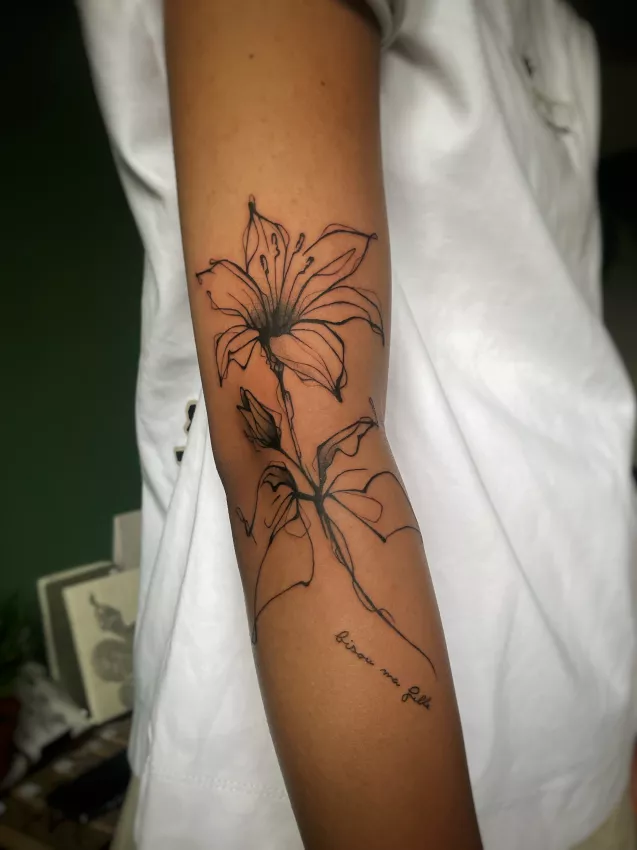
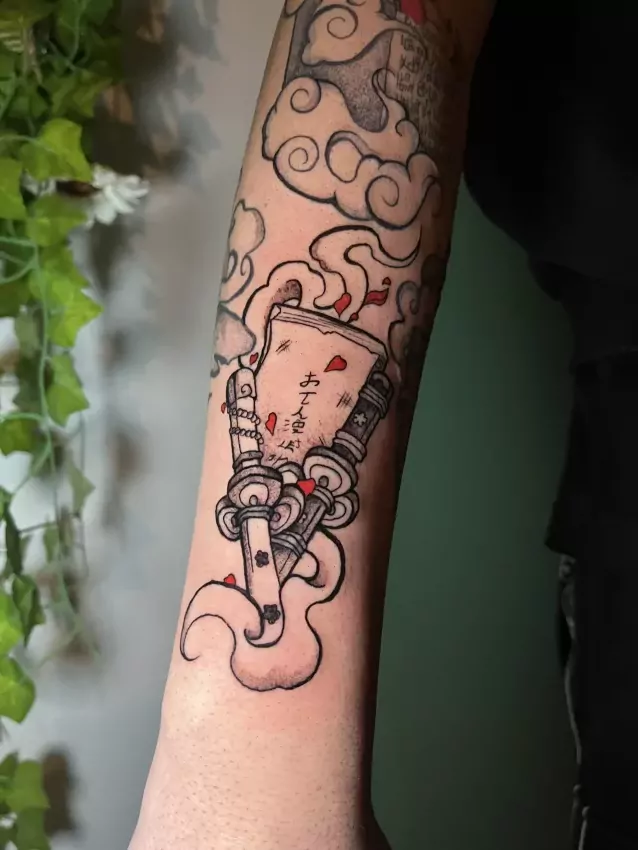
My style is heavily inspired by decorative arts. I love drawing slightly kitsch, aged, vintage objects, often mixed with flowers. I also enjoy anything a bit absurd or surreal—objects transforming into flowers, for example. Flowers come back all the time.
I also have a particular attraction to fragmented things: pieces of ceramic, cracked cups. I'm very inspired by Japonisme and English tableware, Art Nouveau, tapestries, and 19th-century industrial design plates.
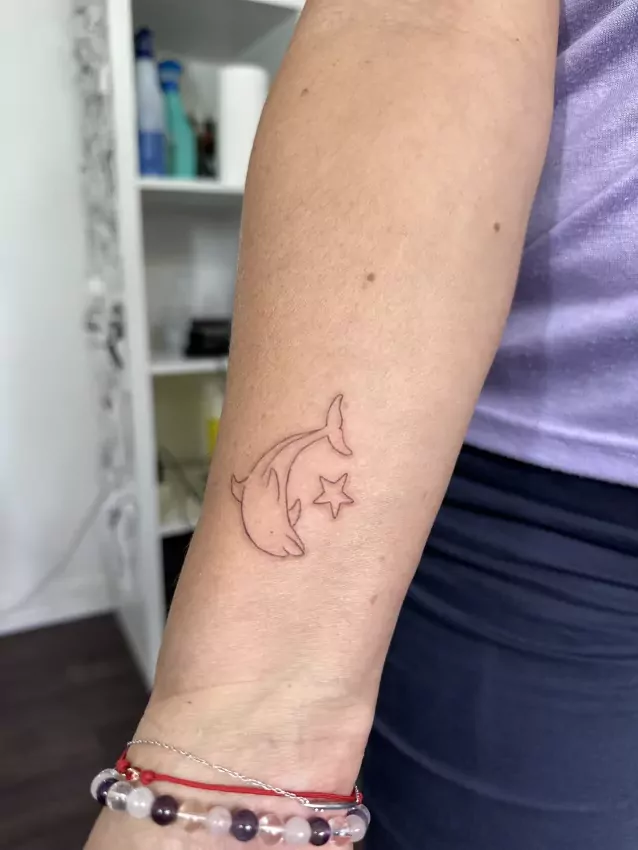
I only work in blackwork, very graphic. I don't do whip-shading type shading, just a bit of engraving style. I'd like to thicken my lines more and play more boldly with contrast between thick outlines and very fine details.
What do you aim to convey through your work?
Something soft and poetic on one side, and very decorative on the other. I'm obsessed with patterns in everyday life, even though I only wear black now. I love when my surroundings are beautiful: the decor, the old dishes, patterned fabrics. People often tell me I'm a 70-year-old woman.
Tattooing fits perfectly into this idea of ornamentation, of sublimating, of decorating the body. And above all, I want people to have a good time.
What's your vision of the tattoo craft?
I was trained the old-school way, in the sense that tattooing is my only job, not a side hobby. I'd like it to stay that way, to be sustainable, even if the context can be complicated sometimes.
I accept any project as long as I'm capable of executing it properly. If someone else is more competent than me for a specific style, I'd rather point them elsewhere.
I'm very attached to hospitality, to the time spent together, to sharing tea or coffee, to talking about the design, to creating a real human connection. I don't like working assembly-line style, even though I've experienced some pretty intense conventions and guest spots.
What are your current projects?
Alongside tattooing, I engrave vintage mirrors that I find at flea markets, carving into them with a Dremel. I'd love to develop this work further. I'll be a temporary exhibitor in a creator's boutique in Lyon 7 this spring to sell my mirrors. I still have a ton of production to do.
I'd also like to create paint-by-numbers postcards, open an online store and a website before the end of 2026, and attend the Clermont-Ferrand convention in the fall.
Right now, my big personal project is my new apartment. I finally have a home of my own. I want to paint everything, fix up furniture, go thrifting, decorate. It makes me deeply happy. And I'm also trying to take care of my body, which took a beating this winter.
Is there a topic that's particularly close to your heart?
Yes, the balance between professional and personal life. Setting boundaries for my work is really hard. Either I work too much, or I say yes to everything. Self-discipline when you're self-employed—it's a real struggle.
There's also the fatigue from guest spots, the relationship with your body as a work tool, the feeling of legitimacy, imposter syndrome. Sometimes I'm still scared that one day someone will discover I don't really know how to draw or tattoo.
My elbow fracture and the stitches on my hand reminded me how important it is to take care of your body. I tend to push myself very far, sometimes too far.
If you'd like to follow her work, find her on Instagram!