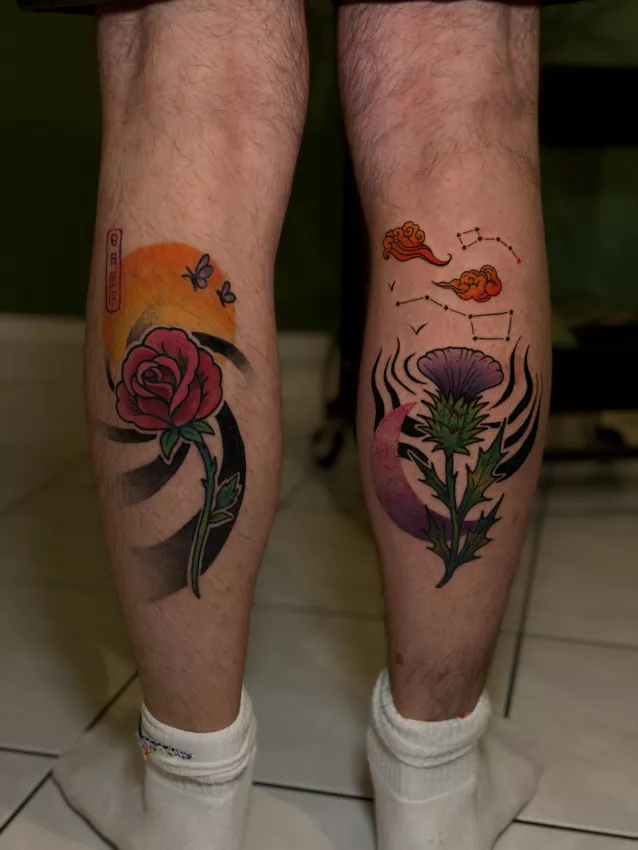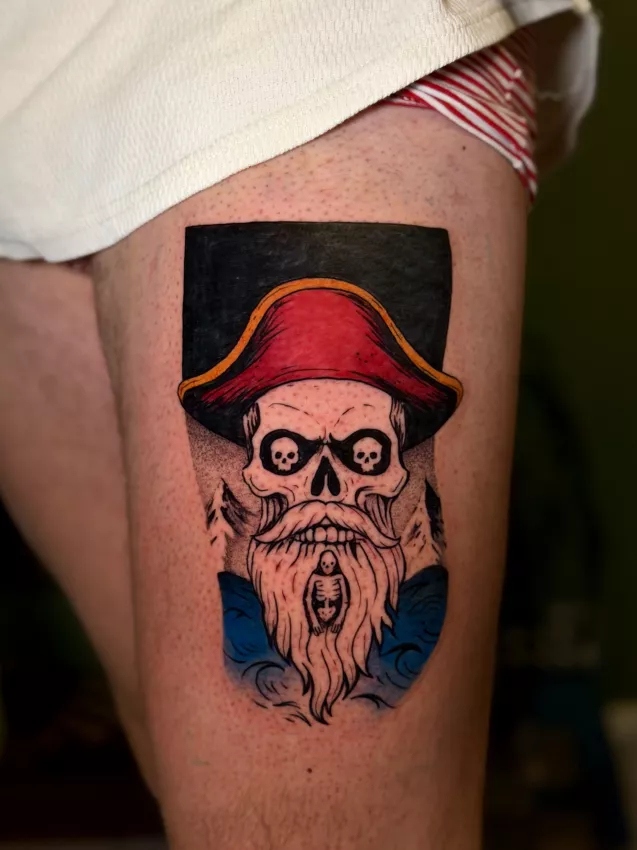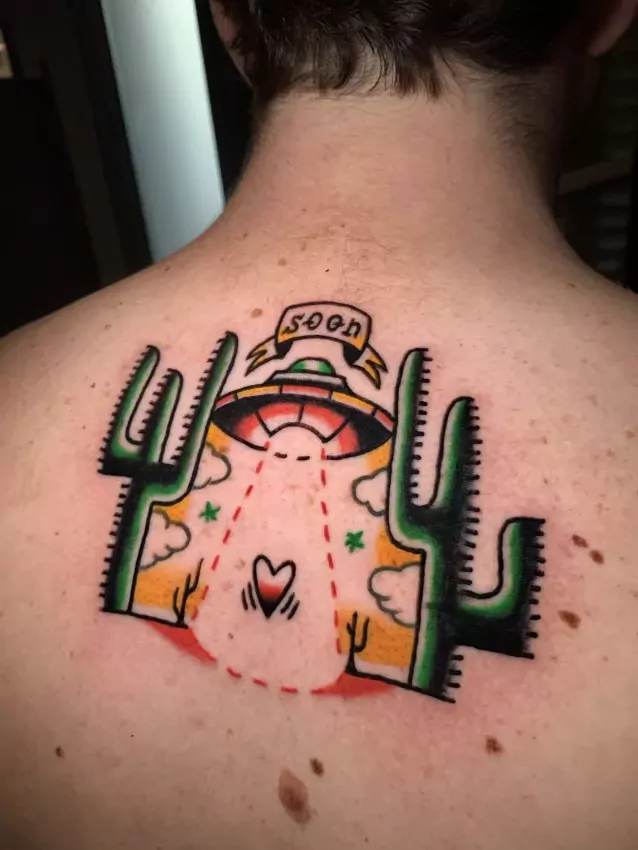
I’m going to say something that sounds stupid: a beautiful Instagram account does not automatically mean a good tattoo appointment.
It is useful, yes. It is a shop window. It is often even the first door people walk through.
But Instagram is also the kingdom of tight crops, kind lighting, contrasts doing yoga, and fresh tattoos shining like fairground doughnuts.
So choosing your tattoo artist is not just choosing the prettiest photo.
It means choosing a person, a style, a setting, a way of working. And, small technical detail, someone who is going to put a needle into your skin for a while.
Check whether the artist really does the style you want
You want engraving-style work? Look at engraving-style work. You want Japanese? Look at Japanese. You want fine floral? Look at fine floral. You want heavy, black, readable lettering? Look at heavy, black, readable lettering.
Some tattoo artists are versatile. Thankfully.
But if a portfolio looks like a restaurant menu with fourteen cuisines, eight homemade desserts, sushi and raclette, I get a little suspicious.
Not because it is automatically bad. Because tattooing is a craft of details. Every style has its rules, its traps, its possible ugly aging.
On the artists page, the point is not just to know who works at the studio. It is to see the worlds. The lines. The subjects that keep coming back. The body placements. The level of detail. What each person actually wants to defend.
Look for healed tattoos when there are some
A fresh tattoo is flattering.
The skin is red, the ink is dense, the photo is taken at the right moment. It can be gorgeous. It can also hide things.
A healed tattoo tells another story. The lines have settled. The blacks have lost their shiny effect. The greys have softened. The colours have found their real face.
If the artist shows healed work, that is a good sign.
It does not mean everything has to be published. Clients do not always want to come back for a photo, and we are not going to chase them down the street with a ring light. But seeing a few healed projects helps you understand how the work lives.
The vibe matters, even for a small tattoo
Even for a small tattoo, you should be able to ask a question without feeling like you are applying for a mortgage at a cold terminal.
You should be able to say you are hesitating about the size. You should be able to ask to see a different placement. You should be able to say you do not understand a piece of advice.
A good tattoo artist can be direct. Even a bit blunt sometimes; we are humans, not vanilla-scented reception kiosks. But they should not pressure you.
Your body is not advertising space for someone else’s ego.
If you feel everything is moving too fast, slow it down. If you feel stupid for asking a question, ask it anyway. And if the answer makes you feel worse than before, that is not a tiny detail.
Check the setting
A studio does not automatically guarantee that everything is perfect. But a clear setting helps.
You know where you are going. You can see the environment. You can ask questions. There are often other people around. It is more reassuring, especially for a first tattoo.
Signals to take seriously: very late appointments without a clear reason, refusing to let someone come with you, a strange or changing address, pressure to pay quickly, refusal to answer hygiene questions, a vague portfolio, stolen photos, inconsistent styles.
I am not saying this to scare you. I am saying it because tattooing is intimate. And intimate things deserve a clean frame.
You can also read what we say about the real role of a tattoo studio. Deep down, a studio is not just four walls and a tired coffee machine. It is a frame.
Be wary of the tattoo artist who says yes to everything
An artist who says yes to everything is very tempting.
Yes to copying the image. Yes to making it tiny. Yes to doing it on fingers. Yes to doing it in white. Yes to doing it tomorrow. Yes to doing it cheaper.
At some point, that looks less like availability and more like a fire alarm playing the flute.
A good tattoo artist sometimes says no.
No because it will age badly. No because the area will not hold. No because the drawing is too small. No because the image is copied. No because the project does not match their style.
It is frustrating in the moment. But often, it is a form of respect.
We already went into this in why your tattoo artist refuses your project. Spoiler: sometimes the no protects your tattoo better than the yes.
Watch out for copied references
Coming with references is useful.
Coming with someone else’s exact tattoo and saying “I want this, the same” is something else.
A tattoo already worn by someone belongs to a story, a body, an artist. Copying it as-is is poor. And often worse, because the project was not designed for you.
What works better: show what you like in each image. The line. The mood. The density. The placement. The composition. The level of contrast.
Then the artist can create for you instead of replaying a soft photocopy. We also talk about this in the article on Pinterest, ChatGPT and projects that need adapting.
Key things to remember
- A beautiful portfolio is not enough. Look at the style, the setting, the vibe.
- Healed tattoos are often worth more than a very shiny fresh photo.
- A good tattoo artist can explain, adjust, and sometimes refuse.
- Warning signs should not be ignored.
- Choosing your tattoo artist is already part of building the project.
At Studio Pixel, the point of a collective is precisely that we can guide you toward the right person for the project. We do not all have the same hand, and that is a good thing. Otherwise we would be a photocopier with cold coffee.
If your project is still blurry, send the elements anyway: idea, placement, size, references, rough budget if you have one, and what you want to avoid.
And sometimes, choosing your tattoo artist already means accepting that the project will change a little along the way.
Sources
- French Public Health Code, tattooing by skin puncture and piercing: https://www.legifrance.gouv.fr/codes/section_lc/LEGITEXT000006072665/LEGISCTA000018150106/
- Order of 5 March 2024 on hygiene and sanitation certification: https://www.legifrance.gouv.fr/jorf/id/JORFTEXT000049268085
- A day with a tattoo artist! - YouTube: https://www.youtube.com/watch?v=HAU6416Qwwg