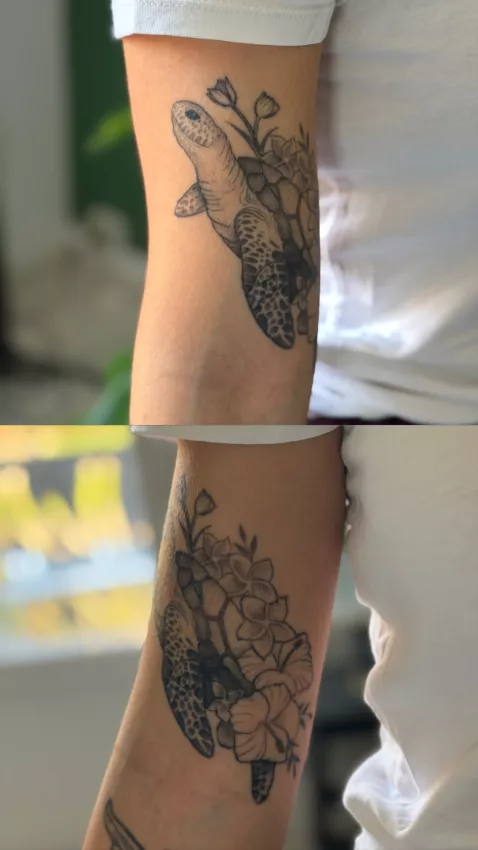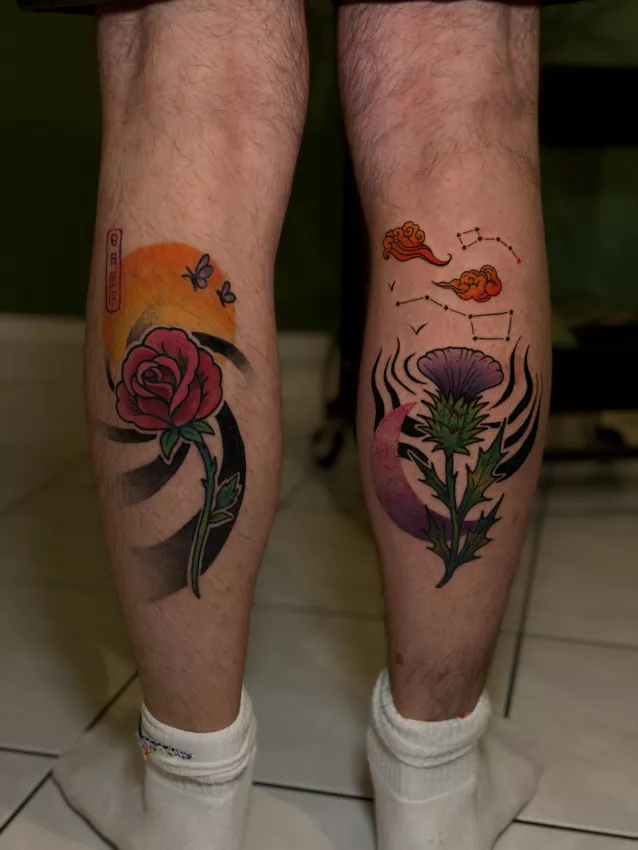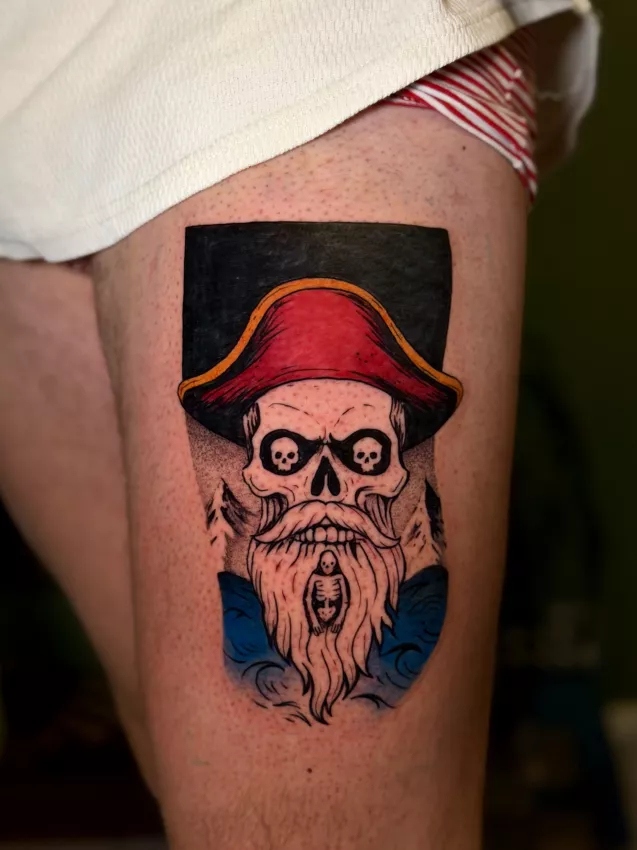
Last week a client came back for his check-up. Old-school forearm tattoo, done three months earlier. I take a look. Black held up well, lines are clean. I tell him: "You're good, no touch-up needed." He looks at me, almost disappointed. He was expecting to go under the needle again.
A lot of people think touch-ups are automatic. That a tattoo needs a second "finishing" session, like a coat of varnish.
Truth is, it's more nuanced than that.
Why We Touch Up (or Don't)
A tattoo is ink deposited in the dermis, the deep layer of your skin. During healing, your skin pushes some of the ink out. That's normal. On a well-done tattoo, this loss is minimal — about 5 to 10% of the ink, mostly in solid black areas or thin-skinned spots.
A touch-up makes up for that loss, or fixes a spot where the ink didn't take well.
But here's the thing: if the tattoo was applied properly — right needle depth, right saturation, right technique — there's often nothing to touch up. On my tattoos, I'd say about one in three clients comes back for a touch-up. The rest? Their skin kept everything just fine.
When to Come Back
The right time is after full healing. Not before. So minimum 4 to 6 weeks, sometimes 8 if it's a slow-healing area (ribs, foot, ankle).
Coming back too early means tattooing skin that's still fragile, reopening a healing wound, or distorting the design from residual swelling. I've seen people show up after two weeks saying "it's ugly, there are holes" — but it was just the skin peeling.
Be patient. Let your tattoo finish its full healing cycle. Then we assess.
What Gets Touched Up Most Often
The spots where ink struggles to hold are usually:
- Fine outlines going through thick or scarred skin
- Large black fills where saturation can be uneven
- Friction zones (belt line, watch strap, back of the hand)
- Extremities (fingers, ankle, top of the foot) where cell turnover is faster
- Little white spots or "pinholes" in a fill
White ink too. White rarely holds on the first pass. If your tattoo has pure white areas, plan for a touch-up. Not bad technique, just physics — white pigment is coarser, skin rejects it more easily. But it's fixable in one pass.
How Much It Costs
The awkward topic.
Policies vary by studio. At Studio Pixel, touch-ups are free within 6 months of your tattoo, on areas I judge as insufficiently inked. No questions, no extra charge.
But: it's my call, not yours.
If you come back six months later saying "I want the black to be blacker," or "I'd like to make it bigger," or "actually I want a different shape" — that's not a touch-up. That's a modification, maybe even a new tattoo. And that costs.
Some studios don't offer free touch-ups at all. Others charge partially. Best to ask before getting tattooed: "What's your touch-up policy?" If the artist says "none," that's a red flag. If they say "we'll see case by case," that's healthy.
The rate for a touch-up as a standalone session depends on the area and time: expect between €50 and €150 for a small local touch-up.
When Touch-Ups Are a Bad Idea
There are cases where I say no.
- A badly done tattoo — blown out, scarred, healed with texture: touching it up without rethinking it is putting a bandage on a fracture. Sometimes you need to cover it entirely or wait a year before considering a fix.
- An allergy or skin reaction: if your skin reacted to the ink, we don't put more ink on top. We see a dermatologist and figure out if a pigment change is possible.
- A tattoo over scars or stretch marks: ink retention is unpredictable. Sometimes perfect, sometimes not. A touch-up on scar tissue can disappoint a second time too.
And then there's the tattoo that aged naturally 5, 10, 20 years later. At that point, a simple touch-up rarely cuts it. Sometimes you need to go over the whole design, redraw it, adapt it to skin that's changed.
What a Touch-Up Session Looks Like
It's shorter than the first session. We only go over the targeted spots. No special anesthesia, no special prep. You show up, I look, we mark the spots, I re-ink the gaps.
The pain is slightly different: the skin has been traumatized before, so it's a bit more sensitive. But since we're working small areas, it's over fast.
Healing after a touch-up is exactly the same as the first time. Same routine, same care. No shortcuts.
What I've Learned Over the Years
The best clients for touch-ups are the ones who followed aftercare to the letter, protected their tattoo from the sun, and come back with a fresh-tattoo photo to compare.
The worst? The ones who let their tattoo dry out, scratched it, baked it in the sun, and show up three months later saying "it's your fault it looks bad." Spoiler: it's rarely my fault.
So if you take away one thing: follow your aftercare instructions, protect from the sun, and if you're unsure, take a photo. Send it to me before coming in. 9 times out of 10 I'll tell you if it's worth the trip or if your skin is just doing its job.
And if I say you don't need a touch-up, don't be disappointed. It just means your tattoo was done right.