Japanese tattoo hits you fast. Even if you know nothing about it, you can feel the weight. Waves, flowers, dragons, koi carp, masks, black backgrounds, full sleeves. It isn't a small symbol dropped somewhere randomly between two appointments, right after picking up a triangle sandwich.
At the studio, when someone mentions irezumi, I always ask whether they want "a Japanese vibe" or a real large composition inspired by traditional Japanese tattooing. Those are not the same promise. In one case, we're talking about a motif. In the other, we're almost talking about architecture on skin.
Irezumi: what are we actually talking about?
The word irezumi refers to tattooing in Japan, often associated with traditional Japanese tattooing. In the Western imagination, people mostly think of large pieces: full back, sleeves, chest, legs, with motifs integrated into a background of waves, clouds, wind, flames, or petals.
This style has a dense history, between folk art, prints, marginality, bans, and social codes. It doesn't summarize to "dragon + flower + wave = Japan." That would be convenient. It would also be as poor as a restaurant that puts three plastic bamboo sticks and calls it an immersive experience.
If you want an inspired piece, you need to choose the elements with coherence. A Japanese motif works through overall composition. Empty space, movement, and backgrounds matter as much as the main subject.
Classic motifs
The koi carp often evokes perseverance, fighting upstream, effort. The dragon points to power, protection, a force less brutal than in Western imagery. The tiger gives an earthy, dense, combative energy.
Flowers also play a role. Chrysanthemum, peony, lotus, and cherry blossom don't carry the same season or mood. If you're going for a floral motif, my article on flower tattoo meanings can help set a first intention.
Masks, like the hannya, need even more caution. They carry strong symbolic weight. There, it's better to avoid the decorative version copied without understanding.
Why larger areas work better
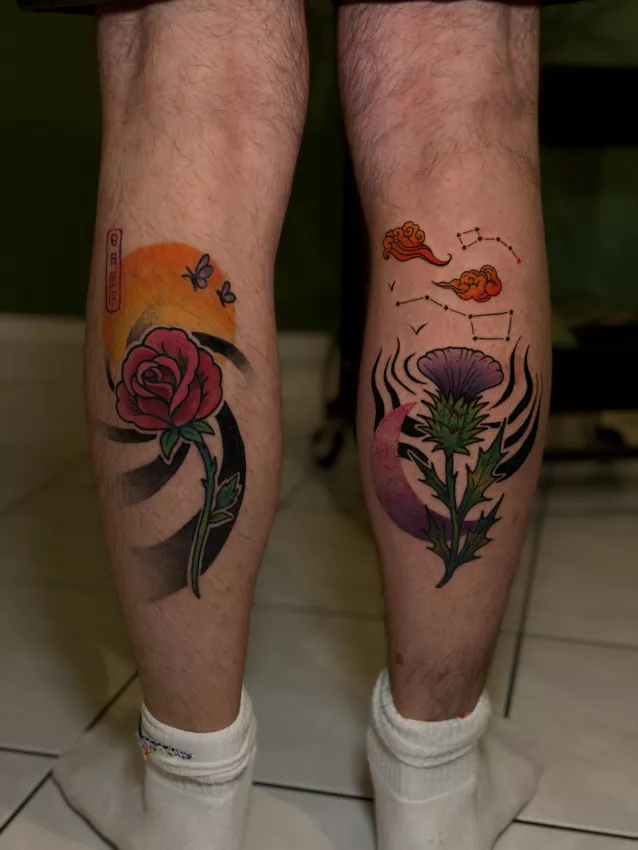
Japanese tattoo loves space. A back, a sleeve, a thigh, or a calf let the design breathe. Motifs can respond to each other, backgrounds can guide movement, contrasts can build.
On a small area, you can certainly make an isolated Japanese motif. A small peony, a wave, a mask, a stylized koi. But you have to accept that it isn't the same thing as a complete irezumi composition.
The back is often the royal format for this kind of project. Keep the idea simple: the larger the piece, the more you can respect the visual language of the style.
The FAQ can also help with practical questions before starting a big project: deposits, touch-ups, companions, fear, duration, and general organization.
Color, black, and contrast
Traditional Japanese tattooing often uses bold colors and solid black. Backgrounds create clear reading. The main subjects stand out. That's why many pieces age well: they have strong structure.
Black and grey can also work, especially for a more contemporary adaptation. But if everything becomes too soft, too smooth, too light, you lose the power of the style.
A large Japanese piece should be readable from far away and interesting up close. If it's only beautiful in an Instagram zoom, that's a bad sign.
Cultural precautions
Being inspired by a style isn't forbidden. Doing it carelessly is another matter. Some symbols have a history, a religion, a cultural place. The minimum is to research, not to mix every motif at random, and to avoid exotic costume play.
That also applies to kanji. If you want Japanese text, have it checked by someone competent. Not by a Google Translate screenshot. Skin deserves better than a permanent grammar mistake.
Japanese tattoo can be a truly beautiful direction if you respect the style, composition, and meaning. No need to become an aggressive purist. Just don't treat an entire tradition like a sticker sheet.
Health, ink, and session length
Large pieces demand more from the body. Several hours, sometimes several sessions, healing by zones. Come rested, eat before, plan appropriate clothes, and follow the aftercare.
Inks can cause reactions, rarely but really. The FDA reminds us that ink reactions can appear right after tattooing or later: Think Before You Ink: Tattoo Safety. That doesn't mean panic. It means seriousness.
What I'd keep in mind
- Irezumi is often designed as a global composition.
- Japanese motifs have codes: don't choose at random.
- Larger areas do the style more justice.
- Solid black, contrast, and backgrounds are essential.
- Recommended cover: large Japanese composition, wave or peony, wide 1200x630 framing.
Japanese tattoo can be magnificent when approached with respect and patience. You don't need to become a historian. But you at least need to avoid treating an entire tradition like a basket of stickers.