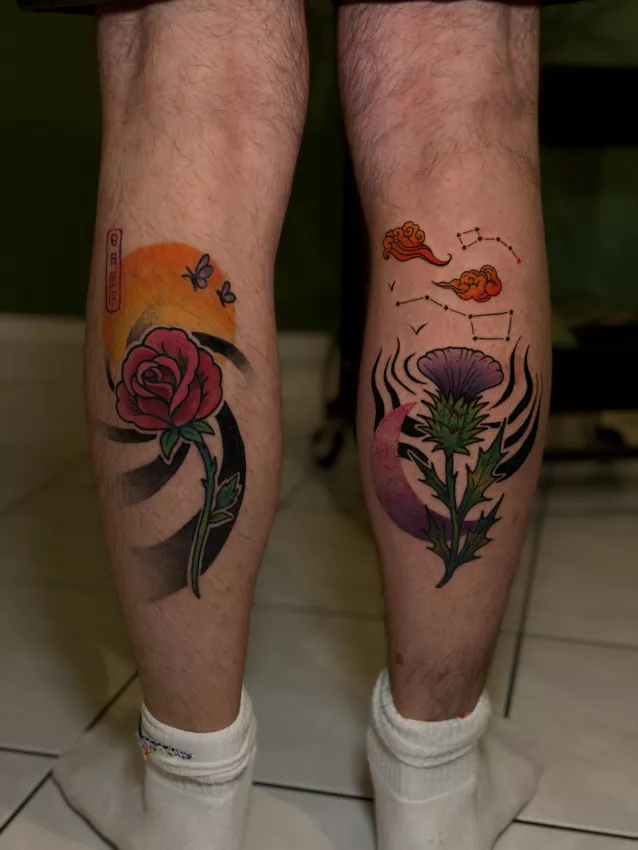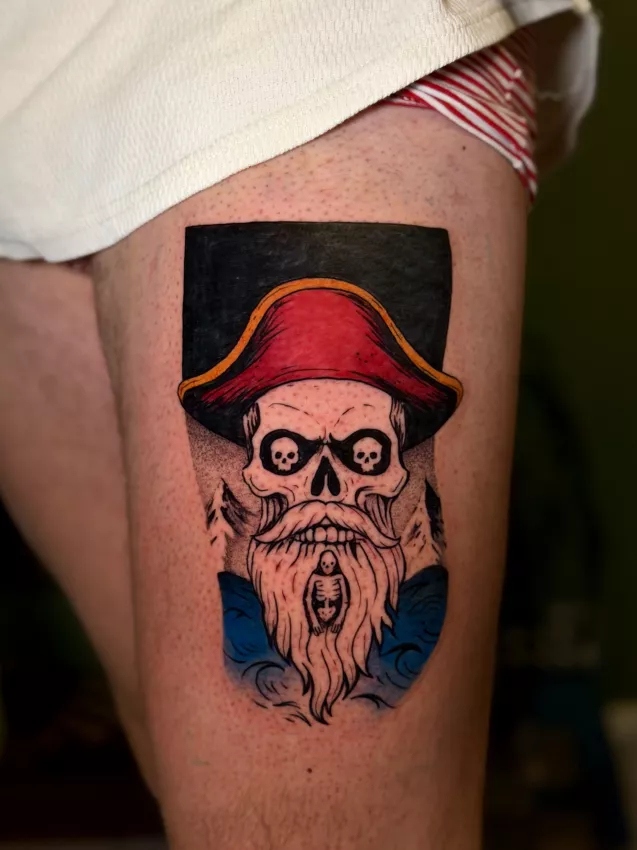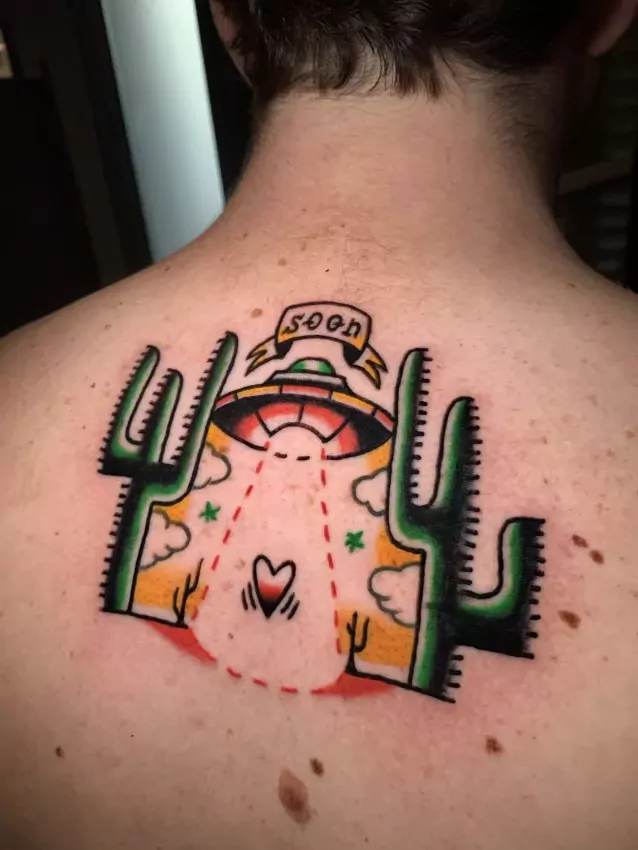
The moon looks like the chillest tattoo motif. And then it brings up fifteen conversations. Thin crescent behind the ear, moon phases on the forearm, moon with flowers, moon and sun, black moon, full moon, moon with a slightly sad face. You start with a little circle in the sky and suddenly you're talking about cycles, night, femininity, sleep, grief, transformation, magic. All for a rock that reflects sunlight. That's pretty wild.
At our tattoo studio in Grenoble, the moon comes up a lot. It's easy to understand and very flexible visually. It can be tiny, ornamental, dark, funny, naive, mystical, almost cartoonish. It can also bridge different elements: flowers, stars, animals, astrological signs, words.
But like any very popular symbol, it can quickly become generic. A little crescent moon by itself looks nice. But you have to ask yourself: why this one, where, at what size, in what style? Otherwise you end up with a symbol that looks more like a weather icon than a thought-out tattoo.
What Does a Moon Tattoo Mean?
The moon is often tied to cycles. It changes shape in the sky — new moon, crescent, quarter, full moon, then back. Perfect motif for talking about periods, change, starting over.
It can also evoke night, intuition, dreams, calm, mystery. Some people give it feminine symbolism, others connect it to time, melancholy, someone they lost, or just wanting to keep a little piece of sky on their skin.
The important thing is not to believe there's one official meaning. A moon can be about your grandmother, an insomnia phase, a summer, a life chapter, or just a shape you find beautiful. And that's already enough.
Crescent Moon
The crescent is the most requested version. It's thin, readable, easy to place. Works well behind the ear, on the neck, wrist, ankle, collarbone, sometimes fingers — though fingers are a whole different story when it comes to healing and longevity.
A crescent can be very simple, almost jewelry-like. Or filled with ornaments, flowers, stars, textures. But heads up: the smaller it is, the more you have to simplify. A two-centimeter crescent with a full forest inside usually ends up looking like a confused little comma.
The crescent can face up, down, or toward your body. Orientation changes a lot. Stupid detail, but important. A badly oriented crescent can feel weird, like a smile that doesn't know if it's happy.
Moon Phases
Moon phases are very popular. Clean graphic line, usually on the forearm, spine, sternum, neck, ribs. It's a motif that tells the cycle idea well.
You have to watch the regularity and size. Small moons need to stay readable. Shading shouldn't turn into a series of blobs. If the motif is on the spine or sternum, you also need to think about body axis. A slightly off alignment becomes obvious fast.
You can make moon phases very thin, very black, textured, stippled, abstract. Or break the line with a flower, a star, a short phrase. No need to go full astronomical calendar version.
Moon and Sun
The moon and sun duo usually talks about balance: day and night, calm and energy, two people, two sides. It's a classic motif, sometimes very beautiful, sometimes very seen.
To make it more personal, you can skip the ultra-standard sun/moon face combo. Play with shapes, textures, positions. The sun can be just a glow, the moon just a crescent, the two can respond to each other without touching.
Also a good idea for matching tattoos. One person takes the moon, the other takes the sun. But careful with rushed couple tattoos. The moon stays, even when the sun moves out.
With Flowers, Stars, Animals
The moon pairs well with flowers. A branch around a crescent, a hanging flower, a botanical composition. It softens the look, makes it more alive.
With stars, you stay in the sky. Simple, effective, but avoid the scattered generic constellation approach. A few well-placed stars beat a rain of cosmic confetti.
With an animal, the moon changes vibe. Cat, wolf, butterfly, snake, bird. A cat under the moon gives a more nocturnal energy. A butterfly with a moon can speak about transformation. A snake makes it stranger, more symbolic.
Where to Place a Moon Tattoo
Behind the ear: discreet, but simplify.
On the collarbone: very nice for a crescent or small composition.
On the forearm: perfect for moon phases or a more detailed moon.
On the neck: pretty, intimate, but careful with hair and friction during healing.
On the sternum: strong, symmetrical, usually more painful.
On the ankle: discreet, but friction from shoes and socks counts.
The placement should follow the motif's shape. A round moon is easier to position. A vertical or horizontal composition needs more thought.
Common Mistakes
First: going too small. A tiny moon can be cute, but if it has too many details, it won't age well.
Second: stacking every symbol. Moon, sun, star, flower, astro sign, quote, snake, date. At some point the tattoo looks like an esoteric shop closing in five minutes.
Third: picking a meaning before the design. The symbol can be important, but the tattoo needs to work visually on your body first.
Fourth: copying a very fine moon you've seen everywhere. It's fine to like a popular motif, but might as well redraw it for you.
How to Make It More Personal
Pick a specific phase. A full moon tied to a date, a crescent because you like its shape, a black moon for a darker mood.
You can add a flower, a small object, a particular star, a texture, a meaningful spot. You can also choose an imperfect moon, hand-drawn, less symmetrical.
If you want to work on a moon motif without falling into the generic icon trap, you can book an appointment at our Grenoble studio. We can start from a very simple image and give it a real place on your body.
A moon tattoo doesn't need to scream that it's about cycles. It can just be there, discreet, a little strange, like a reminder that things change even when you feel like you're going in circles.
Sources
- NASA, moon phases: https://moon.nasa.gov/moon-in-motion/moon-phases/
- Encyclopaedia Britannica, Moon: https://www.britannica.com/place/Moon
- American Academy of Dermatology, tattoo aftercare: https://www.aad.org/public/everyday-care/skin-care-basics/care/tattoo-care