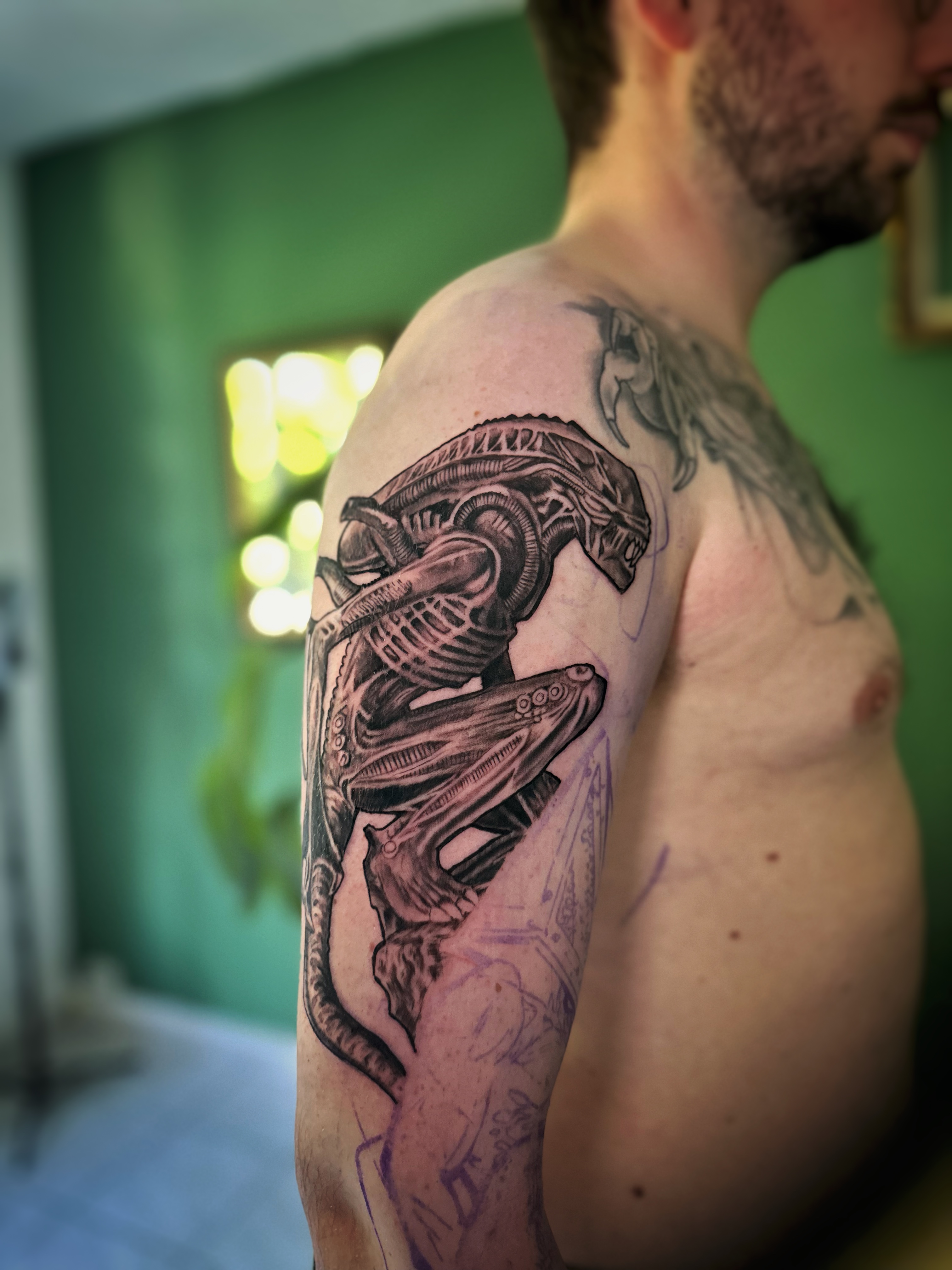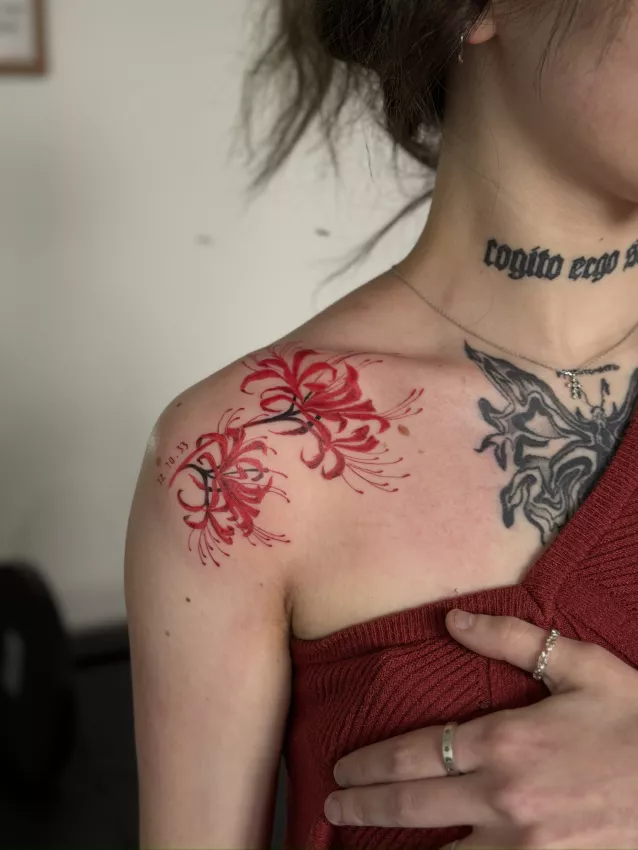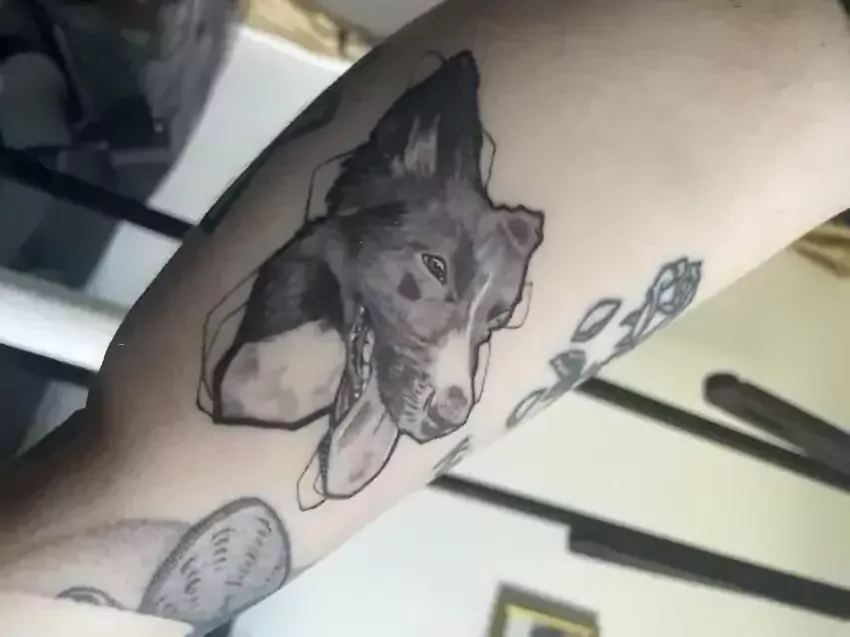
A few years ago, a guy walks into the studio with a very specific idea. He wanted a full skeleton, invisible in daylight, visible only in a club under UV lights.
I asked if he'd ever seen an aged UV tattoo on a real person. Not on Instagram. Up close, under real light. He said no. I showed him photos. He walked out with a classic tattoo. A skeleton hand, but visible all the time. Smart call.
UV tattoos come in waves. Every time an influencer posts their "invisible tattoo that glows in the dark," we get inquiries. And every time, I have to explain why it's not as cool as it looks.
What is UV ink?
The idea: pigments that react to ultraviolet (UV-A) light by emitting visible light — fluorescence. Under normal light, the tattoo is invisible or very subtle. Under blacklight, it lights up.
Two types:
— Phosphorescent ink: absorbs light and re-emits it in the dark. It "glows in the dark" for a while. — Fluorescent ink: only glows under direct UV. As soon as the light goes off, nothing.
The vast majority of "UV" inks are fluorescent, not phosphorescent. A tattoo that glows on its own like a sticker in the dark basically doesn't exist — and if it does, it lasts maybe 20 minutes after hitting it with a powerful flashlight.
The real risks
Here's where it gets messy. The composition.
Historically, UV inks contained phosphorus or zinc salts. Problem: phosphorus is toxic at high doses. The first-gen UV inks from the 90s-2000s caused burns, chronic infections, severe allergic reactions, and even localized skin cancers (documented cases — sources at the end).
Modern inks use organic fluorescent pigments (stabilized "glow pigment" powders). Less dangerous, but nobody specifically regulates these pigments.
In Europe, the REACH regulation sets limits on CMR substances (carcinogenic, mutagenic, reprotoxic) in tattoo inks. But fluorescent pigments often sit in a gray zone — not explicitly banned, but their long-term safety isn't proven either.
What I've actually seen in people with UV tattoos:
— Persistent irritation (red, itchy, swollen area) — Keloid scarring more frequent than with standard inks — Rapid design degradation (looks bad after 2-3 years) — Delayed dermal reactions (sometimes 6 months after the session)
Nothing systematic, but frequent enough that I say no to most requests. Check our article on tattoo ink allergies and how to recognise them.
How it ages
Even if you ignore the health risks, there's a second problem: it doesn't hold up.
Fluorescent pigment, once injected into the dermis, degrades relatively fast. Under UV from the sun (ironic, I know), it loses its ability to glow. After 2-3 years, the tattoo barely reacts to blacklight anymore. And since the pigment is often lighter, it leaves an unflattering whitish or yellowish trace in daylight.
I often compare it to white tattoos. Gorgeous the first few months. Then it yellows, fades, and you wish you'd gone with standard ink.
Feedback from clients with 5+ year old UV tattoos:
— "At first it was amazing, now you can't see anything under UV." — "The design turned yellow, looks like a scar." — "I had to get it covered with a normal tattoo."
Is it even legal in France?
Gray zone.
EU REACH regulation (2022) bans certain substances in tattoo inks. But it doesn't specifically ban UV inks. If the fluorescent pigment respects CMR concentration limits, it's technically allowed.
But in practice, very few manufacturers provide full technical datasheets for their UV inks. Without a datasheet, the tattoo artist takes a legal risk by using them. Not to mention the medical risk.
Honestly, in serious studios in Grenoble, nobody uses UV ink. Some artists do it privately, on request, but it's rare and usually advised against by professional unions.
I tested a UV ink from a reputable German brand on a small design in 2018. Result: irritation for 3 months. The design never glowed as bright as the promo photos. And it visually disappeared under UV within 2 years. I stopped after that.
If you want a comparison with other inks, check our article on watercolor tattoos. Same deal: initial look vs aging are two completely different things.
Alternatives
You want a glow or subtle effect without the UV risks?
— Light inks: a well-done white tattoo is subtle without being invisible. Less risky but still yellows over time. — Standard ink, subtle design: a small fineline tattoo, sparse dotwork — can give a "barely there" effect without UV risks. — Hidden placement: a tattoo under your clothes, where nobody sees it but you. Same "secret" effect, zero risk. — UV body paint: for a night out, no permanent marking. A pot of UV paint costs 15 bucks, lasts one night, zero medical risk.
My take
If you want my opinion: UV tattoos today are an immature product. Too many unknowns about composition, too much negative feedback, too little medical track record. Standard inks have 30-40 years of data, toxicological studies, and stable formulations.
The rare cases I'd accept: a very small design, on an area with little sun exposure, with recent ink, a known brand, and a full technical datasheet. Even then. Rarely worth it.
Compare that to vegan tattoo ink, which is much better documented today — you see the difference between a mature practice and an experimental one. UV tattooing is still experimentation on human skin.
Have you ever seen a UV tattoo in real life? Not on TikTok. For real, on a human who's had it for years? I have. And that was enough for me.
Sources
- Journal of the American Academy of Dermatology — UV tattoos: complications and case reports (2019)
- REACH Regulation (EU) 2020/2081 — Restrictions for substances in tattoo inks
- ANSM — Opinion on fluorescent tattoo inks (2021)
- PubMed — Long-term dermal reaction to UV-reactive tattoo pigments (2023)
- Tattoo Ink Safety — Analysis of fluorescent pigment composition (K. L. M. 2022)
- British Association of Dermatologists — Position statement on UV tattoos (2020)