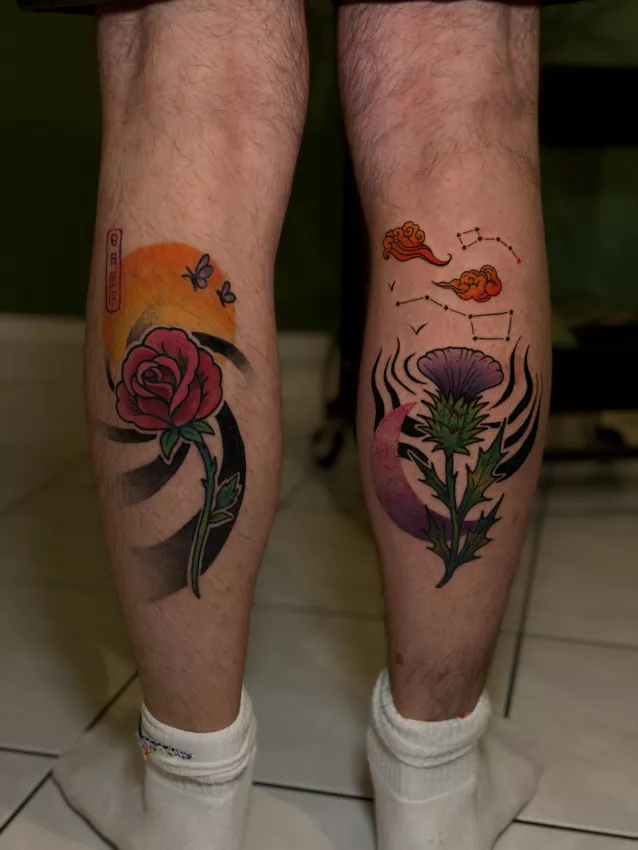
At the studio, flowers come back all the time. Really all the time. Sometimes it is a rose for a grandmother. Sometimes a peony just because it looks good. Sometimes a birth flower found on Google at midnight, with a slightly blurry screenshot and a message like: "I don't know if this can be tattooed, but I like the idea."
And often, the real question arrives after that: "what does it mean?"
First thing: a flower does not have to mean anything. You can get a flower tattoo because it has a cool shape, because it fills a spot well, because it softens a design that feels too harsh, or because you love plants even though you kill every single one at home. This happens to very decent people.
But flowers still carry symbols. They drag stories around with them. Uses, clichés, memories, grief, love, gardens, bouquets bought in a panic at 7:48 p.m. And that is probably why they work so well as tattoos.
At our studio in Grenoble, flowers come up a lot because they let you make a tattoo personal without writing the whole story in capital letters.
Why flowers are so popular in tattooing
Graphically, a flower is useful. It can be tiny or huge. Delicate or heavy. Very detailed or almost abstract. It can follow an arm, fill a shoulder, wrap around an animal, cover an old tattoo, sit next to a phrase, or become a whole composition.
It can feel soft without being bland. It can feel dark without becoming aggressive. A black rose does not have the same mood as a naive little daisy, obviously, but both are immediately readable.
It is also a motif that survives almost every style. Traditional, neotrad, ignorant, fineline, blackwork, ornamental, color, engraving, botanical. The flower is basically the potato of tattooing: you can cook it a thousand ways. Not the most elegant comparison, but honestly quite accurate.
Rose: love, memory, intensity
The rose is the queen of floral tattoos. It is everywhere. On arms, hands, chests, flash sheets, old traditional boards, band covers, jewelry, cemeteries, and perfumes that cost too much.
In tattooing, the rose often talks about love. But not only romantic love. It can evoke a person, a loss, a family story, a beauty with a bit of danger in it. The thorns change the message a lot. A rose without thorns can feel softer. A rose with a stem and thorns can say: this is beautiful, but it is not defenseless.
Color matters too. Red suggests passion, life, intense love. Black suggests grief, elegance, memory, sometimes a breakup. Pale pink feels more tender. Yellow, depending on the culture, can evoke friendship and joy, but also more mixed meanings.
Lotus: rebirth, calm, crossing through
The lotus is often linked to rebirth or elevation, because it grows in murky water and produces a very clean flower. That is why we see it a lot in tattoos connected to a difficult period, rebuilding, or personal transformation.
The trap with the lotus is the "catalog spirituality" effect. It can quickly turn into something very seen, very polished, a bit yoga-mat-in-a-shopping-cart. But when it is well drawn, well placed, and built with a real graphic intention, it can still be powerful.
It works well on the sternum, back, forearm, neck, or ankle. It can be geometric, ornamental, or more organic. If you want a lotus, ask yourself what actually interests you: the shape, the symbol, the calm feeling, the memory of a period in your life. That helps avoid choosing a symbol just because three websites said "inner peace."
Peony: abundance, beauty, character
The peony has something generous about it. It is round, full, almost excessive. In Japanese and neotrad tattooing, it can create magnificent pieces, very alive, with movement and petals going everywhere.
Symbolically, it is often linked to beauty, wealth, honor, sometimes luck. But visually, it mostly tells something dense. A peony is not a shy little flower hiding in a corner. It takes space. It says: yes, I am here, and I wore my biggest dress.
On a thigh, shoulder, hip, or arm, it can really carry a composition. Small, though, it quickly loses what makes it charming. Too many petals in too little space and you get decorative salad. Usually not the goal.
Daisy, lavender, poppy, thistle
The daisy has something direct. We think of childhood, fields, the "loves me, loves me not" game. It can evoke innocence, simplicity, lightness. Simple does not mean silly. A daisy can be very beautiful as a tattoo, especially when the graphic direction is confident.
Lavender almost smells through the image. You think of the South of France, linen cupboards, holidays, those little sachets someone has definitely given you at some point. In tattooing, it often evokes calm, memory, softness, sometimes a specific person. It works well in fine line, but not too tiny.
The poppy has a strong color and a fragile shape. It can speak about memory, grief, war in some contexts, but also freedom, summer, something that grows where nobody expected it. In red, it grabs the eye immediately. In black and grey, it becomes more melancholic.
The thistle is requested less often than the rose, and that is exactly what makes it interesting. It pricks. It has a strange shape. It is not trying to be cute. It can symbolize protection, resistance, attachment to an origin. Visually, it has character.
Birth flower: good idea or shortcut?
Birth flowers are requested a lot. It is a practical idea for representing a child, a parent, siblings, or a date. One flower per person, then you build a bouquet. It can make a family tattoo feel softer than a list of first names.
I like the idea, but only if you do not stop at the table you found online. Two websites can give different flowers. Traditions change depending on the country. So it is better to treat it as a starting point, not a law carved into marble.
The most interesting part is often composing several flowers together. Then the tattoo becomes almost a small family garden. More personal than a generic symbol.
How to choose your flower
Start with what you want to feel when you see it. Not with "what is the official meaning." An official meaning is still something written somewhere by someone who does not know you.
You can choose a flower because it grew at your grandparents' place. Because it was printed on a dress. Because it reminds you of a city. Because its shape works well on your arm. Because it makes you laugh. Because it is the only plant you managed to keep alive for more than eight days, which is already a victory.
Then we look at the style, size, and placement. Some flowers need space. A tiny peony becomes muddy. Lavender that is too large can lose its delicacy. A rose can do almost anything, but that is exactly why you need to avoid the automatic rose with no intention behind it.
If you want to explore more possibilities before choosing, we made a complete list of 100 flowers in tattooing with more detailed meanings.
A floral tattoo does not have to be polite
We often associate flowers with something soft. But a flower can be strange, dark, funny, almost aggressive. A very graphic black flower on a calf does not say the same thing as a small fine bouquet on the ribs.
That is what makes them interesting. Flowers are familiar, but they are not frozen. They can carry an intimate story or simply make a very strong composition.
In the end, maybe the right question is not "what does this flower mean?" It is more: "what do I want it to say on my skin?"
If you want to build a bouquet, a birth flower tattoo, or a floral design that actually fits the body, you can book an appointment at the studio in Grenoble. We can start from one precise flower, or just from a mood.
Sources used
- Encyclopaedia Britannica, botany and flowers: https://www.britannica.com/plant/flower
- The Met, floral motifs in decorative arts: https://www.metmuseum.org/toah/hd/flow/hd_flow.htm
- Royal Horticultural Society, botanical information: https://www.rhs.org.uk/plants